I've been listening to a lecture series on existentialism. The focus is on philosophers Kierkegaard, Heidegger, Nietzsche, Camus and Sartre. These are some heavy dudes. The lecturer points out all the many ways they disagree and also the common philosophical thread that runs through their work: the way to find true freedom in this life is by taking total responsibility for one's choices and one's responses to the events of life. This is called living an authentic life. An authentic life has passion and commitment. Most people live much of their lives in a reactionary mode. Almost everyone has brief moments of clarity, but the life of the ordinary person is generally unreflective in nature. The existentialists encourage us to live our lives in the present and make our decisions through reflective choice.
In conformity, one does the right thing because that is what's expected by others. Non- conformity is the other side of the coin. The rebellion of youth is an example of this. Both are reactionary ways of existing. Following the existential philosophy one may conform or rebel, but the choices are made reflectively and in this way one’s life becomes more “authentic”. Sartre found authenticity in the French underground. Rebelling against the Nazis gave him meaning and purpose that transcended his individual needs and wants. Viktor Frankl found it when he was a prisoner in a concentration camp. Helping the other prisoners gave him the meaning he needed to survive. The existentialists tell us that finding meaning in life leads to true freedom.
When I first attended college at Florissant Valley Community College in North St. Louis County, it was1965 and I guess I wasn't ready. I flunked out. My concerned parents sent me to a counselor, who advised me to go into the military. He told me “Not everyone is cut out for college.” But at some point during my Army experience, I decided I wanted an education. My heroes were writers. Not just writers, but writers and adventurers like Hemingway, Jack London and Jack Kerouac. Both Jacks were in the Merchant Marines for a while. When I was a soldier on my way to Vietnam aboard a Merchant Marine troopship, I enviously watched the sailors as they went about their daily chores. They worked hard and had purpose throughout their day, unlike us soldiers, the cargo, who had absolutely nothing to do. We sat or wandered around the ship with too much time to think about where we were headed. I imagined myself as one of those seaman, after a hard day's work, lying on my bunk in the evening, making entries in my journal for a novel I would someday write.
In Kerouac's novel On The Road, he describes living and working with migrant workers. He describes this as a deeply satisfying time in his life, doing exhausting work in the fields all day and then falling into bed at night tired but happy. The long tedious hours of back breaking work forced him to engage fully in life. For Hemingway it was imminent death that forced his characters into this open, honest and vital way of living.
Some of the existentialists spend too much time raging against normalcy. Reacting in a negative way to the bland, unaware, mundane, un-passionate existence of others is just another reactionary mode. Without compassion for the human condition, we miss the mark. When we truly face our own inevitable death, when we truly face our ultimate aloneness in the world, when we become quiet and genuinely reflective, we discover a deep connection with and compassion for all life. The peace and security people yearn for can only be found by letting go of striving for it. Totally accepting oneself in whatever situation one is in is the way to true freedom. The Buddhists' call it non-attachment or the middle way. Let go of all clinging and be totally present.
Wednesday, December 29, 2010


Saturday, December 18, 2010
Pick of the Litter
I got first pick of the litter. Cheska was Suzanne's dog, the mother, and the father was a dog named Red. Both dogs were Springer Spaniels, although Red was so big we suspected he might not be pure-bred. Cheska was medium to small size, had reddish brown(liver) on her back with a white underbelly and white on her legs and muzzle. She could be dependent and whiny, whereas Red was strong, independent and had a regal appearance. Red's body was white with a smattering of reddish spots. Most of the color was on his head. He was owned by Suzanne's former boyfriend.
Suzanne and I lived together for a time in the early '70s, when one could easily drift in and out of relationships. Ours wasn't meant to last, but we shared a deep love of dogs as well as love and respect for each other. She was still living in Eugene in the house we bought together, but I had moved to Seattle and was eking out a living as a fry cook during the day and cab driver at night. I had been dog-less since my beagle, Blossom, was run over by a car driven by a young man going way too fast on a country road. I wasn't sure I wanted another one.
But getting pick of the litter was quite an honor and I was secretly pleased that Red's master was getting second choice. I can't remember how many puppies were in the litter, but a lot, maybe 8 to 10. Suzanne called me when they were old enough to adopt. There is absolutely nothing cuter than a bunch of Springer puppies. I couldn't resist and took my time watching them before making my decision.
Suzanne let me know which puppy the ex-boyfriend wanted. It was the biggest male with the droopiest face. He was lethargic, spending most of his time sitting and watching the other puppies play. There was something appealing about his mellow nature and for a while I thought he was the one I wanted. It may have also had something to do with taking the dog that Suzanne's irresponsible, cavalier yet ruggedly handsome ex wanted. But as I continued watching the puppies, I kept noticing one medium sized male, always on the move. Some of the puppies fought a lot, some slept most of the time and some whined until mom returned to feed them. But this little male went around bumping the other dogs with his nose until he got one of them to play with him. He didn't get angry or give up. He would bump a puppy, back up and then furiously wag his cropped tail. After two or three times of this, without response, he would move on to the next one.
When I touched his back, he looked up at me and for a brief moment I could tell he thought maybe I'd play with him. But when he realized I was just sitting there watching like that fat puppy in the corner, he again turned his attention to the other dogs.
I named him Murray after the Jason Robards character in the movie A Thousand Clowns. Murray was a writer for a children's television show. But he grows to hate the shows host and the conformity of it, so he quits. Murray realized that most people go through their lives reacting and conforming to others and to the “system” and lose the basic childlike joy of living. His nephew Nick lives with him and Murray wants him to live life with gusto and to stand up to the hypocrisy and phoniness of others. Throughout the movie Murray tries to act as an example for his nephew. In one scene he goes out into the street very early in the morning, looks up at the New York apartment buildings and begins yelling at them as if he were a camp counselor. “Campers, volleyball will be held out on the main lawn at 10 am sharp”.
I lived with Murray the Springer for over 15 years. We ran together, hiked together, lived in a variety of houses and towns. He endured my ups and downs with girlfriends and marriages. He loved and played with my son and two stepsons. He tolerated our other pets as they came and went. Throughout it all, I could count on him to bump me on the leg each morning wag his stump of a tail, back off and look at me straight in the eye as if to say, Isn't it great to be alive. What fun activities are we going to do today?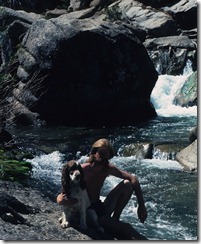
Murray had a stroke in 1990. His left side stopped working. When I took him to the Vet to be put down, we took a few minutes to sit outside the office by the side of a small stream. He knew something was wrong, but when he heard the birds chirping in the trees, his floppy ears perked up and he looked at me. Again I saw that little puppy. What do you say we go chase after those birds? I'm reminded of the Jerry Jeff Walker song Mr. Bogangles. “His dog up and died... after 20 years he still grieves.” It's been over 20 years since Murray died and I haven't gotten another dog and probably won't.
Suzanne and I lived together for a time in the early '70s, when one could easily drift in and out of relationships. Ours wasn't meant to last, but we shared a deep love of dogs as well as love and respect for each other. She was still living in Eugene in the house we bought together, but I had moved to Seattle and was eking out a living as a fry cook during the day and cab driver at night. I had been dog-less since my beagle, Blossom, was run over by a car driven by a young man going way too fast on a country road. I wasn't sure I wanted another one.
But getting pick of the litter was quite an honor and I was secretly pleased that Red's master was getting second choice. I can't remember how many puppies were in the litter, but a lot, maybe 8 to 10. Suzanne called me when they were old enough to adopt. There is absolutely nothing cuter than a bunch of Springer puppies. I couldn't resist and took my time watching them before making my decision.
Suzanne let me know which puppy the ex-boyfriend wanted. It was the biggest male with the droopiest face. He was lethargic, spending most of his time sitting and watching the other puppies play. There was something appealing about his mellow nature and for a while I thought he was the one I wanted. It may have also had something to do with taking the dog that Suzanne's irresponsible, cavalier yet ruggedly handsome ex wanted. But as I continued watching the puppies, I kept noticing one medium sized male, always on the move. Some of the puppies fought a lot, some slept most of the time and some whined until mom returned to feed them. But this little male went around bumping the other dogs with his nose until he got one of them to play with him. He didn't get angry or give up. He would bump a puppy, back up and then furiously wag his cropped tail. After two or three times of this, without response, he would move on to the next one.
When I touched his back, he looked up at me and for a brief moment I could tell he thought maybe I'd play with him. But when he realized I was just sitting there watching like that fat puppy in the corner, he again turned his attention to the other dogs.
I named him Murray after the Jason Robards character in the movie A Thousand Clowns. Murray was a writer for a children's television show. But he grows to hate the shows host and the conformity of it, so he quits. Murray realized that most people go through their lives reacting and conforming to others and to the “system” and lose the basic childlike joy of living. His nephew Nick lives with him and Murray wants him to live life with gusto and to stand up to the hypocrisy and phoniness of others. Throughout the movie Murray tries to act as an example for his nephew. In one scene he goes out into the street very early in the morning, looks up at the New York apartment buildings and begins yelling at them as if he were a camp counselor. “Campers, volleyball will be held out on the main lawn at 10 am sharp”.
I lived with Murray the Springer for over 15 years. We ran together, hiked together, lived in a variety of houses and towns. He endured my ups and downs with girlfriends and marriages. He loved and played with my son and two stepsons. He tolerated our other pets as they came and went. Throughout it all, I could count on him to bump me on the leg each morning wag his stump of a tail, back off and look at me straight in the eye as if to say, Isn't it great to be alive. What fun activities are we going to do today?

Murray had a stroke in 1990. His left side stopped working. When I took him to the Vet to be put down, we took a few minutes to sit outside the office by the side of a small stream. He knew something was wrong, but when he heard the birds chirping in the trees, his floppy ears perked up and he looked at me. Again I saw that little puppy. What do you say we go chase after those birds? I'm reminded of the Jerry Jeff Walker song Mr. Bogangles. “His dog up and died... after 20 years he still grieves.” It's been over 20 years since Murray died and I haven't gotten another dog and probably won't.
Thursday, December 9, 2010
Thoughts on Christian Science
I was raised in Christian Science. It was a good religion for a kid. The message was very positive. In fact in Sunday School we were taught that God is only positive. There are 7 specific synonyms for God; Life, Truth, Love, Mind, Soul, Spirit and Principle. I learned that we are all part of God or more precisely, individual expressions or reflections of God. We learned that the material world is an illusion and that we are really spiritual beings. Sin was defined as our belief in the material world. The degree to which we believe in and are attached to matter, is the degree to which we suffer. Everything in the material world passes away, so the task of a Christian Scientist is to develop a Spiritual sense, which can be defined as a deeper understanding of our true relationship with the Divine.
I preferred the Christian Science message over the one at my previous Sunday School, which was Presbyterian. There was a scary side to their message. I felt I had to watch what I did or else I would be punished. Once I asked the Sunday school teacher if animals went to Heaven, he told me, no they didn't, only people. He probably didn't speak for all Presbyterians, but at the time I decided I didn't want to go to heaven, I wanted to go where ever my dog went. When I asked the same question of the Christian Science lady, she told me that all living things are part of God and that includes my dog. Also that Heaven was not a far off place, but was always present and could be experienced in this life. We didn't need to wait until we died. The way to experience heaven, I was told, was to quiet down, “be still and know that I am God”.
When I got older and started attended Christian Science church services, I had a lot of trouble “being still” and paying attention. The church service was excruciatingly boring to me. There are no preachers in Christian Science, just two readers. One reads passages from the Bible and one from Mary Baker Eddy's book Science and Health. There is absolutely nothing extemporaneous about the service, robots could do it.
When Katie and I lived in Rochester, New York we attended a Christian Science church a few times. It was a huge beautiful Cathedral, but there were only 7-10 people attending the services. We found that to be true in other areas as well. In Port Angeles, Washington, during the 5 years we lived there, the local Christian Science Church first downgraded to a Society and then went out of business altogether. Christian Science seems to be a rapidly declining religion. I Speculate that there are two main reasons for the decline. One is the rigidity of the way the religion was set up by Mrs. Eddy and the other is their stand on not receiving medical help for physical problems.
The First Reader at one of the CS churches we attended had a huge goiter on his neck. I'm sure he was praying like crazy for it to go away, and probably felt guilty that it wasn't. I know that guilt all to well. I wanted to tell the guy, just have a doctor take that thing off your neck and get on with your life. I suffered from migraine headaches for years. I called a Christian Science practitioner to pray for me. She asked me a lot of questions and one of them was, Are you receiving any medical help for them? I told her I took a migraine pill when I felt one coming on. This allowed me to go to work and function, as opposed to lying in a dark room all day. This particular woman was a renowned Christian Science teacher and writer and she told me she couldn't help me as long as I continued to take the medication. Her response turned me off and I started to argue with her over the phone until she told me she had to go. I kept taking the medication and stopped reading Christian Science.
Mrs Eddy was not the first person to use the term Christian Science and it wasn't a brand new philosophy that she discovered. She learned the basics from a spiritual healer named Phineas P. Quimby. After being healed by him, she hung on to his manuscripts and for a time considered herself his “disciple”. On her own she worked out the details of this new theology and spiritual healing in conjunction with Biblical Scriptures and much of it I'm sure came to her through revelation. It is fair to say she greatly advanced this theology. But it always bothered me that she took all the credit for everything she wrote and taught even though there are passages lifted directly from Quimby's manuscripts. And many other spiritual writers of the day had published works developing the same ideas. But it's hard to find mention of Mr. Quimby or any of the other spiritual writers and healers of the time in any of the official Christian Science literature. It's like they never existed. In fact it's taught in the church that any other person's interpretation of Christian Science or spiritual healing is tainted by “carnal” or “mortal mind”. So Christian Scientists give her all the credit for all the teachings. To be a loyal Christian Scientist you need to accept that all other systems of spiritual healing are wrong and only her system is the “Truth”. So like so many religions, you either buy into it entirely or you don't.
In the late 1800's, Emma Curtis Hopkins was at one time Mrs. Eddy's star student. She rose to the top of the organization and became editor of the Christian Science Journal. She then suddenly disappears from the Christian Science literature and is never to be found again. Ms. Hopkins saw similarities in Christian Science philosophy and Eastern Philosophy, particularly Hinduism. Also she realized that the evolution of the Christian Science philosophy cannot be contained within one organization. Revelation and Truth do not belong to any one individual. She began to talk about this publicly and Mrs. Eddy booted her out of Christian Science. Ms. Hopkins went on to teach classes which spawned the New Thought movement including Unity, Religious Science and Divine Science.
It's obvious that Ms. Hopkins learned much from Mrs. Eddy. The teachings are almost identical. Emma Hopkins sited the basic difference between her beliefs and Mrs. Eddy's with the following distinction; Mrs. Eddy states, there is no life, truth, intelligence nor substance in matter. Ms. Hopkins makes the subtle, but profound distinction that, there is no absence of life, truth, intelligence nor substance in matter.
Since childhood I've had a “love/hate” relationship with Christian Science. I suppose it's not unlike the feelings of Catholics, Jews and other Protestants concerning the religion they were raised in. Sometimes I am fiercely attracted to the religion and want to join up and believe everything it has to teach and at other times I reject it vehemently and see inconsistencies and hypocrisies within it. In the end I strive to remain true to an honesty of Being.
Wednesday, November 24, 2010
Wes Montgomery and a Giant Doobie
Recently Arizona passed a medical marijuana law. It's still a very contentious topic, each side vehemently arguing against the other. Back in the ’60s and ‘70s I would have predicted the complete legalization by now. At this stage of my life I have mixed emotions about it though. I have some very fond memories from when I was in college at the University of Oregon in the early ’70s that include pot smoking. It seemed so innocent back then. Friends would gather. We'd be having a few beers, listening to music and someone would roll a joint and pass it around. Then we'd all become quiet, listening intently to the music until at some point something would strike one of us as funny and we'd begin to laugh hysterically. The laughing and giggling wouldn't stop until we realized we had a terrible case of the munchies and then we'd raid the frig.
One of the arguments used against legalization is that it is a gateway to other drugs. I think there is some validity to this argument, but for me it was a gateway to mystical experiences. I was influenced by authors like Aldous Huxley, John Lilly, Carlos Castenada, Joseph Chilton Pierce and Ram Dass. I was never tempted to drop acid even though it was the holy grail of psychedelic drugs. As a war veteran I was extremely afraid of getting stuck in a bad trip. I felt I could control marijuana. I knew just how much to smoke to get into a comfortable heightened state of perception. It helped me to understand that peace is in the present moment. It also taught me to let go of past and future, which is the only true freedom. But of course when the drug effect wore off, I was flung back into my neurotic self, feeling lethargic and sometimes with a bad cough and a headache.
I never heard of marijuana until 1967. I was on leave from Army training and getting ready to ship out to Vietnam. I went to a friend’s house to visit him and his girlfriend. They put on some strange music (Vanilla Fudge) and said it sounded even better when you're high. I thought they meant high on alcohol and I said “Well then let’s have a few beers.” His girlfriend looked at me like I was nuts and said, “Don't you know that stuff will kill you.” They told me marijuana was a much safer drug than alcohol and it made you peaceful instead of violent. They asked me if I'd like to try some, but I declined. They weren't too interested in hanging with me anymore after that, so I left.
The first time I smoked a joint was in Vietnam. The doobies over there were almost cigar- sized. You could purchase a bunch of them already rolled and neatly placed in a baggy for about five bucks. One evening in base camp, my black friend Mitch invited me over to his hooch to listen to music. Mitch was from Chicago. He wasn't trained in intelligence like the rest of us, but he was a grunt, an infantryman, assigned to our detachment as an aid to the First Sergeant. Our First Sergeant was an old man, probably in his 40s. He fought in World War II in the German Army. We used to refer to him as the First Nazi, behind his back of course. He could barely conceal his prejudicial thinking. How Mitch got assigned to him I'll never know, Karma I guess. Mitch had an attitude. He was a draftee and didn't care for Army life. He wore his helmet at a rebellious angle and when he wasn't wearing a helmet, he would stick his large comb in his barely perceptible afro hair-do. The First Sergeant could get pissed off just looking at him.
Mitch called me “Little Bro”. He said I was the only white guy he ever called that. I don't know if I believed him, but I liked it. We both loved Motown music. On the top of our favorite musicians list were Marvin Gaye and The Temptations. Smokey Robinson was like a God and then there was Mitch's local Chicago band The Impressions led by “my man” Curtis Mayfield. That night in his hooch, Mitch said he had some music he wanted to turn me on to. It was the smooth jazz electric guitar of “his man”, Wes Montgomery. While we were listening to Wes, he lit up one of those honking doobies, took a hit and passed it to me. I had already adopted the Vietnam “what the fuck” attitude and took a big hit. He told me to hold it in, which I tried to do until it exploded from me in a fit of uncontrollable coughing. After he and the rest of the guys in the hooch stopped laughing, Mitch coached me in how to inhale and avoid this happening again.
I'd like to say we then kicked back and enjoyed the smooth jazz together, but I became hyper aware of the explosions and small arms fire in the background. I thought I had become used to it. But it seemed louder and closer. I couldn't sit still anymore and got up to leave. I felt I needed to get my rifle, flak jacket and helmet from my hooch and then dive into a bunker. I was aware that my heart was beating hard and fast. Mitch stopped me and said I was just feeling the effects of the pot, but I wasn't convinced. He finally sent someone over to get my friend Rob. Rob was college educated and older than the rest of us. He was 22. Rob took me outside and talked to me until I finally calmed down.
Mitch and I had plenty of opportunities to practice the art of smoking Ganga and I became quite efficient at it. One day Mitch was gone. No one could tell me where he went. I assume he really pissed off the First Nazi and got sent out to an infantry platoon. I don't know whether he survived the war or not, but I hope he did. No one else ever called me “Little Bro”.
Saturday, November 20, 2010
Buying a New Car
Katie and I just went through the new car buying experience and came out the other side with a nice car, but we’re hoping not to have to go through that agonizing process again for a long time. We’d been talking about buying a car for a while now. Our Ford Focus was still running strong, but had almost 140,000 miles on it. We researched various cars and decided we wanted a small hatchback that was dependable, safe and got good gas mileage.
Last Saturday I went up to Tucson on my motorcycle to pick up a part I’d ordered. On the way home I passed by a Toyota dealer and decided to stop and see if they had any cars we’d be interested in. I was hoping to just look around a bit without being bothered, yeah right. A salesman swooped in on me before I took two steps on the lot. He was a friendly guy, of course. He asked me what I was looking for and I told him. He showed me a variety of used cars, but they were either too expensive, too old, too big or too something.
This went on for some time. We drove around a very large block in heavy traffic in several different cars, but nothing caught my fancy. Then he remembered a car they had just gotten in. He left me for a while and came back in an almost new Toyota Yaris. It was a strange color, appearing to be an off shade of purple. I got in and the salesman drove it out into the traffic, down the street until reaching a big deserted parking lot where he pulled in. He stopped the car and told me to try it out on some tight turns. I whipped the little car around the lot, swerving one way, then the other. I was having fun. It was like driving a large go-cart. It handled well, had good power and was comfortable.
I repeatedly told the salesman that I couldn’t commit to buying a car unless my wife liked it too. He said, “Not a problem, take the car home, keep it for the rest of the weekend and bring it back on Monday. If your wife doesn’t like it, just turn it in and walk away.” I was getting tired and had the thought’ this will be fun to drive around for a couple days, so I agreed. Then another fleeting thought, she’s never going to gofor this color.
But it wasn’t as simple as just driving the car home. My buddy the salesman added, “First I need you to fill out some papers before you go.” OK, I understand that they can’t just let me drive away in this almost new car. But I didn’t realize I had to go through the entire paperwork process as if I were actually buying it. What had I gotten myself into? First I waited for the financial guy to be able to see me, then they ran a credit check and I waited for the results, then I signed papers until my hand started to cramp. I kept asking the financial guy, “Are you sure I’m not actually buying this car?” and he kept reassuring me, “No, don’t worry, this is just a formality.” I made sure there was a paper saying that if my wife doesn’t approve of the car, the deal is off. The process took several hours and the whole time I was thinking, what in the hell am I doing? She’s not going to like the color.
During a break in the paperwork action and on my way to the bathroom for the umpteenth time, because the salesman kept showing up with another free bottle of water and I kept drinking them, I stopped off to take quick look at the car. The sun was now setting and when I stepped out the front door of the dealership, there was the little Toyota, a deep brown color, the shade of root beer. Silly me, my mind must have tricked me into thinking it was a putrid purple color. I think she’ll like it after all.
I went back in for the last round of paperwork signing and then finally was free to leave. We stashed my motorcycle in the back of the dealership and I took off for Green Valley in the root beer colored Toyota. Even though it was slightly “pre-owned”, it still had that new car smell. When I got home it was pitch dark. After my long winded answer to the question “You did what?” Katie decided to wait and look at the car in the morning. In the morning light we walked out to the parking lot and there it stood. But it wasn’t root beer colored anymore and wasn’t purple either, but of sort of a sickening shade of mauve. Katie’s first comment was “It looks like the color of a corpse.” We walked around it until I found an angle where it looked root beer colored again, but any slight movement to the right or left turned it into a rolling cadaver. “And besides”, she pointed out, “ it’s a two door and we decided we need a four door.”
How had I gotten sucked into bringing home this ugly colored little car? Why did I allow myself to go through all the waiting and paperwork hassle? If I had thought about it, I clearly would have realized this was not the car we wanted. These questions may never be answered. My conclusion is, I cannot be trusted to go into a car dealership on my own. Katie refused to go back with me to return the car. The unspoken words were you got yourself into this mess and you can get yourself out of it. I thought I’d learned my lesson.
When I took the car back on Monday, the salesman was surprised that it had been rejected. I told him we liked the car, but it was the wrong color and we needed 4 doors. He didn’t miss a beat, “Wait here just a minute, I think I have something you’ll really like.” and he took off before you could say, “Oh shit here we go again.” He showed up minutes later in a white Toyota Corolla. It was a lot more money than we wanted to spend and neither of us wanted a white car. But I drove it and liked the feel of it, it had good power, handled really well and had a huge trunk with fold down back seats. Again, I was ready to consider another car that wasn’t the right one. I told the salesman I was not going through all the rigmarole I went through the other day and that I needed to get my motorcycle out of the back and go home. He said, “No problem, I’ll follow you down to Green Valley and we can show the car to your wife.” In a brief moment of sanity I said, “I’d better call her first.” which I did. I told her all about the car and she listened very patiently and then said in a calm and authoritative voice, “Get on you motorcycle and come home now, without the salesman.” So I did.
Even though I told the salesman we’d be back the next day, we didn’t go back, Instead we went to a different dealership and found a car that fits all our criteria. It’s an arctic blue Nissan Versa and it continues to look Arctic Blue no matter what angle you happen to be examining it from. Katie mercifully went through the paperwork process while I zoned out. I couldn’t face doing it again. We are very happy with our new car.
I had spent a lot of time with that Toyota guy. I knew where he was from and why he and his wife moved to Arizona. I knew that he had a problem with his lower back and that he’s going to have it operated on soon. He hopes to buy another motorcycle, a Honda 1300. He was in the Navy, and just missed going to Vietnam. Well he called me the other night “How are you doing? How’s your wife? Did you get home alright the other night on your bike?” Have you been car shopping again?” “Yes,” I told him, “We bought a Nissan and I started to tell him why and that I appreciated all of his efforts to find me a car, but right in the middle of my sentence he said, “OK then.” and hung up. So much for our bonding experience the other day.
Thursday, November 11, 2010
The World Needs Bucky More Than Ever
I’m a supporter of the voluntary simplicity movement. I’m most enthusiastic about it between the times when I’m hungering to buy something new. Right now I’m a strong supporter. I rode my new motorcycle over to my favorite coffee shop and I’m sitting here writing this blog on my new nifty netbook. I am pleased to see the voluntary simplicity concept is catching on with many young people. Only in a wealthy country like ours can there be a movement like this. It’s probably not real popular across the border in Mexico or in other third world countries. You can’t give up what you never had or have no hope of getting.“If humanity does not opt for integrity we are through completely. It is absolutely touch and go. Each one of us could make the difference.” “Pollution is nothing but the resources we are not harvesting. We allow them to disperse because we've been ignorant of their value.” “We are called to be architects of the future, not its victims.” “We are not going to be able to operate our Spaceship Earth successfully nor for much longer unless we see it as a whole spaceship and our fate as common. It has to be everybody or nobody.”
Katie and I have been mindful of living lighter on the earth since the 70s. Since that time we have avidly recycled, mostly driven small fuel efficient cars, flushed our toilet sparingly and gave away or sold possessions we no longer used. The attitude of living more simply allowed us to retire earlier than most people and to retire without a fear of being poor. We now live in a 600 square foot condo, have just one small storage area on our back porch and 3 small closets. It seems we still have plenty of stuff. I can barely remember the many things we got rid of. Realistically looking at our attempts to conserve energy, we still consume way more than most people on the earth. And even if we became super good at conserving and recycling, would it make a difference in the grand scheme of things? Looking to the future, it seems obvious that the entire world can’t participate in the making, buying and throwing away of things at the rate we've been doing it in America over the past sixty or so years. The earth cannot sustain such wasteful activity on that grand of scale. Yet our consumer way of life is spreading around the globe like wildfire. In China, India, South America, and everywhere, people are becoming aware of all the goodies and want them, and you can’t blame them, some of these goodies are pretty cool. The third world is not going to choose voluntary simplicity.
Sometime in the 1970s when I was in college at the University of Oregon, I went to a lecture by Buckminster Fuller. He was an architect, inventor, environmentalist and all around genius type of guy. He invented many things, but is most known for his invention of the geodesic dome. He also coined many terms, one being ephemeralization, which basically means doing more with less. At the time of the lecture, he was in his 80s. Sitting there in the audience listening to him speak, I noticed the large hearing aides behind each ear attached to thick black glasses with coke bottle lenses. I had to really concentrate to follow what he was saying. He talked in giant circles. I thought this old guy was just rambling on, but what I initially judged as a meandering, disjointed monologue, all of a sudden came together in brilliant clarity.
He emphasized that we cannot continue our current way of living on the earth and hope to survive.
Bucky was a renaissance man. I remember him saying that the fall of western civilization will be because of over-specialization. I’ve been thinking about that statement off and on all these years and see examples of it everywhere. In the medical field you have to go to a special doctor for your feet, your heart, your eyes, your nose and throat, your allergies, your diabetes etc. And if you’ve ever had a house built, the list of people that need to be involved is almost endless. We are losing the big picture by each one of us focusing only on our narrow interests or specialties. He believed that by using our intelligence we could design systems that work for everyone and are in harmony with the environment. Not only could we feed the entire world, but he confidently said we could raise everyone’s standard of living higher than what we currently have in the US.“Something hit me very hard once, thinking about what one little man could do. Think of the Queen Mary, the whole ship goes by and then comes the rudder. And there's a tiny thing at the edge of the rudder called a trim tab. It's a miniature rudder. Just moving the little trim tab builds a low pressure that pulls the rudder around. Takes almost no effort at all. So I said that the little individual can be a trim tab. Society thinks it's going right by you, that it's left you altogether. But if you're doing dynamic things mentally, the fact is that you can just put your foot out like that and the whole big ship of state is going to go. So I said, call me Trim Tab”.
Bucky’s ideas were popular in the sixties and for a while a whole generation of young people cultivated a more holistic view of the earth and its inhabitants. We need Bucky’s ideas again today. He encouraged each one of us to do our part no matter how small. At his grave site there is a small concrete stone above his headstone that is inscribed with the words: “Call me Trim Tab”. The following quote explains this.
—Buckminster Fuller
Each one of us can make a difference and getting serious about voluntary simplicity is a good place to start. Bucky said we can save the world with intelligent design and the help of modern technology. I’m hoping that means I can keep my new laptop. Oh yeah and our TV is getting really old.
Friday, November 5, 2010
The Similarities Between Ricky and Frank
I’ve written quite a few blogs about music. Music was and continues to be an important part of my life. It speaks a language that goes into the senses, passes through the thinking, controlling brain and stirs up the deepest recesses of my psyche. It hits parts of me that I am not aware of, loving parts, hopeful parts, angry parts, sad and grieving parts and the list can go on. At times it even liberates me from all parts and there is no separation between the music and my self.
I grew up with music in the house. My mom loved classical music and played it loud when she did housework. In my head are many classical pieces. I couldn’t tell you who the composers are or the names of the pieces, but I can hum along with the music. My dad loved music as well and whistled a lot when he puttered around the house. He liked popular music and that’s the gene I got. I loved popular music even before rock & roll, but it’s when I first heard Elvis that I discovered my music.
Every generation has its own music and the generation to follow usually hates it. I remember my mom telling me about seeing Frank Sinatra with my dad when they were young. She talked about it as if it were something really special. I was heavily into the Stones at the time and thought, “Who’d want to listen to that corny old fashioned music?” After mom died, I discovered a live Sinatra record in her collection. It was recorded in Las Vegas with Count Basie’s Orchestra and arranged by Quincy Jones. I put it away in my useless record collection. Sometime in the ‘90s my sister gave me a Frank Sinatra cassette tape for my birthday. It contained songs recorded with the Nelson Riddle orchestra during his comeback in the ‘50s. I must have been ready at that time, because I discovered great songs with impeccable musicianship. I bought CDs of the live Vegas performance and the Nelson Riddle years and I now cherish these two recordings along with a Ricky Nelson greatest hits compilation. I love those two guys, they stood up there and sang ‘em straight.
I grew up with music in the house. My mom loved classical music and played it loud when she did housework. In my head are many classical pieces. I couldn’t tell you who the composers are or the names of the pieces, but I can hum along with the music. My dad loved music as well and whistled a lot when he puttered around the house. He liked popular music and that’s the gene I got. I loved popular music even before rock & roll, but it’s when I first heard Elvis that I discovered my music.
The first musician I identified with was Ricky Nelson. I watched him grow up on The Adventures of Ozzie and Harriet. Rock & roll began in our culture with Elvis. His way of interpreting songs became the standard. The problem was no one did Elvis better than Elvis, but everybody tried. His movements, his look and his inflections were all copied by other rock and rollers. Every one agreed he was the “King of Rock & Roll”. Even though Ricky idolized Elvis, he didn’t try to imitate him. Ozzie set him up with a top notch band (his lead guitar player, James Burton, would later become Elvis’) and Ricky sang the songs without theatrics. Like the old crooner, Frank Sinatra, Ricky showed restraint in his delivery and total appreciation of the music. I’ve always liked musicians who didn’t allow their egos to become greater than the music.
Frank was a musical force like Elvis, and a teen idol like Ricky, maybe the first teen idol. He chose his songs well and demonstrated an impeccable understanding and respect for the music and the musicians. He used his voice as one of the instruments of the band, even though it was the main instrument. Ricky had the same style. He didn’t put on airs, but sang the songs straight with feeling and as an integral part of the band. If you want to hear pure unadulterated ‘50s rockabilly rock & roll, listen to Ricky’s many hit songs.
My favorite music, evolving from that era, was Folk Rock, a genre that doesn’t seem to be a category anymore in the music stores. Folk Rock was born when Dylan went electric and Roger McGuinn fused the Beatles’ sound with Dylan lyrics. The Byrds, the Turtles, the Mamas and the Papas, and the Lovin’ Spoonful were some early Folk Rock groups. Folk Rock dominated popular music in the ‘60s and ‘70s.. Folk music was forever fused with Rock and individual artists like James Taylor, Carole King, Joni Mitchell and Jackson Brown were at the apex. The group that ruled the genre was Crosby, Stills and Nash and sometimes Young. In the mid ‘70s the baton was passed to the Eagles who, like the Byrds before them, fused in country music as well. In the late‘60s Ricky formed the Stone Canyon Band with Randy Meisner, who later joined the Eagles, and they helped pioneer the Country Rock sound. Every generation has its own music and the generation to follow usually hates it. I remember my mom telling me about seeing Frank Sinatra with my dad when they were young. She talked about it as if it were something really special. I was heavily into the Stones at the time and thought, “Who’d want to listen to that corny old fashioned music?” After mom died, I discovered a live Sinatra record in her collection. It was recorded in Las Vegas with Count Basie’s Orchestra and arranged by Quincy Jones. I put it away in my useless record collection. Sometime in the ‘90s my sister gave me a Frank Sinatra cassette tape for my birthday. It contained songs recorded with the Nelson Riddle orchestra during his comeback in the ‘50s. I must have been ready at that time, because I discovered great songs with impeccable musicianship. I bought CDs of the live Vegas performance and the Nelson Riddle years and I now cherish these two recordings along with a Ricky Nelson greatest hits compilation. I love those two guys, they stood up there and sang ‘em straight.
Subscribe to:
Posts (Atom)