Monday, February 22, 2016

Chang Mai, A Very Buddhist City


Our hotel in Chang Mai, Thailand is in the “old city”, which is contained in a big square surrounded by a crumbling ancient wall and moat. The “old city” looks only slightly older than the newer parts outside the square. The biggest difference seems to be the size of the streets. Our van driver from the airport had to leave us at the corner because the van was too big to drive down the narrow lanes. We walked the rest of the way to our hotel, past small restaurants, tailor shops, tiny convenient stores, and guesthouses. It reminds me of the narrow alleyways on Mykonos, Greece, but not as white. Tourists are everywhere and always present in the old city, lots of Chinese, but also people from all over the world.

Thailand is predominantly a Buddhist country and in Chang Mai temples or wats are everywhere. "Wat" means enclosure in the ancient Pali language and these religious enclaves are surrounded by walls that separate them from the secular world. Within the walls are temples, shrine halls, bells, Chedis or stupas(large cone structures often with gold leaf on the outside) and more. The temples and structures are elaborate and ornate, inside and out. They make the cathedrals of Europe seem plain. Almost all the temples are open and free to the public, but shoes must be left on the steps outside.  
Statues of Buddha are within each temple with the largest one being the center piece. There are no chairs or benches to sit on. To pray, one kneels on a rug which lays on the immaculate tile floor in front of the altar. Buddhist etiquette requires that one’s feet never point toward the altar. Some of the Chinese tourists kneeled at the altar to pray, but very few westerners did, perhaps they had trouble getting down on their knees and back up again.  

Where there are wats, there are monks. While visiting one large wat, two young monks
beckoned me to sit on a bench near them. When I did, they began asking me questions about myself, where I’m from, how long have I been in Thailand etc. One of the Monks spoke pretty good English, the other didn’t. They seemed happy talking with me and I assumed they called me over because they sensed a depth of understanding that I was somehow projecting. After all I’ve studied Buddhism since the 70s and have attended many Buddhist groups in the US including Vipassana groups that originated here in Thailand.  They asked if I had a question about Buddhism, and I did.
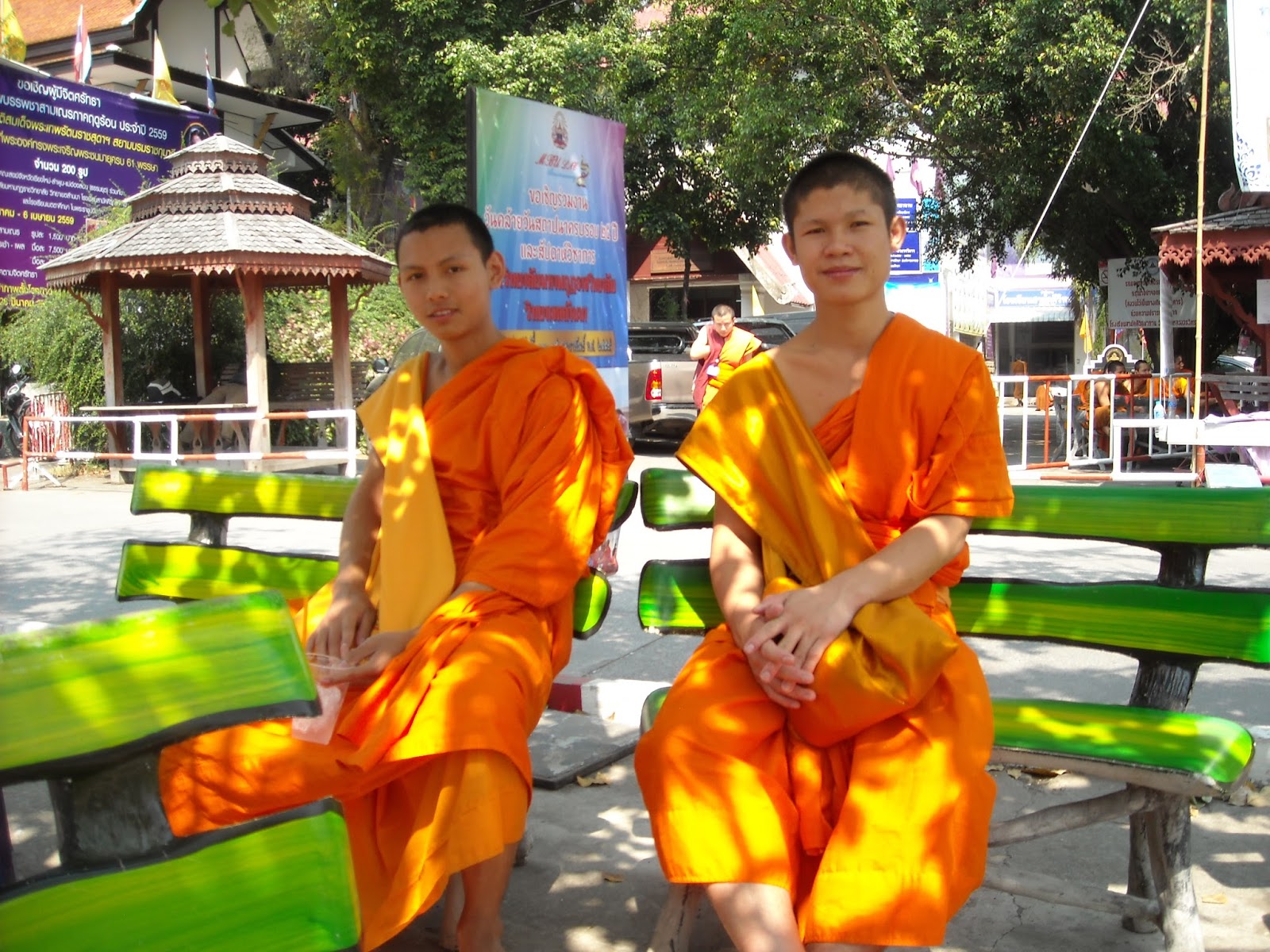
My question was: If Buddhism is a non-dualistic religion, who are they praying to? And isn’t it true that if one prays to any form of outside entity, whether it be a spiritual entity or physical entity, one is entering the dualistic world, the world of suffering, and wouldn’t that be defeating the purpose or to coin a Buddhist phrase, wouldn't one be  mistaking the finger pointing to the moon for the moon itself?

But before I had a chance to ask my question, another western couple came over and began talking with them and they seemed to lose interest in me.  So much for my, “I am special” theory, which probably was my Buddhist lesson of the day.

Buddhism here is complicated. I can’t begin to understand the meaning of all the ritualistic practices. Practitioners bow to statues and offer incense, pour oil, ring bells, get blessed by monks and walk around chedis chanting. There seems to be no end to it.  It’s definitely not the simple Buddhism I studied in the US--meditating, practicing mindfulness, compassion for all living things.  In a college class in the early 70s, the Buddhist Monk teacher told us that all of the teachings of Buddhism are contained in the placing of your shoes before entering the temple.  

We visited Wat Prathart Doi Suthep. It’s way up the mountain just outside the city. At the base of the mountain is Chang Mai University. Monks used to have to walk from there up the mountain path before getting to the steps. Tourists can chose to do this also or be driven right up to the base of the steps. We chose to be driven thinking that if we walked up the entire mountain, we may not be able to get up the 300+ steps.  The Wat grounds way up on the mountainside are spectacular and overlook the city. Katie and I wanted to enter into some spiritual aspect of the place, not just wander around gawking and taking pictures like everyone else, so we decided to walk three times around the giant golden chedi.  Laminated chant cards are in a basket at the entrance and one is supposed to read them and silently chant while circling the chedi. But the words were so foreign to us, we decided to mentally chant the universal Tibetan Buddhist mantra, Om Mani Padme Hum. As I began to slowly walk on the path, I became aware of people behind me. I felt like a slow moving
vehicle going up a steep hill followed by a line of cars. Each time the path widened, three or four people scurried past me, but I “religiously” maintained my slow pace.  Thoughts entered my mind What’s their hurry? Are they trying to get this over with quickly? One young man hurried past me listening to ear phones. It seems that everyone here is just going through the motions, evoking the magic formula that will take away all their troubles. I kept walking slowly and chanting, Om Mani Padme Hum and sensed a separation between my thoughts and my awareness.  By the time I was on my third circle, I was in the zone, peacefully putting one foot in front of the other, a part of but untouched by the whirling world around me.


Sunday, February 14, 2016

Corregidor: A Time of Peace and Healing


It took a couple of hours to ferry from Manila to Corregidor Island. The weather was balmy and the sea calm. We sat in assigned seats, in rows facing forward. Unlike on the Washington ferries, there was no getting up and wandering around to look at the view. A big screen TV hung from the ceiling in the front and a short film on safety and evacuation procedures played followed by an entire Bee Gees concert. It was an old concert, all the Bee Gees were still alive and well. I was feeling better, but still had some stomach and lower abdominal distress.


After I passed out on the floor in the restaurant in Manila, Morgan, the scout Master, fired off a text message to Peter, my stepson, which read: Grandpa Yeager had a fainting spell, he refuses to go to the hospital, but is conscious and talking. Don’t get me wrong, I love being a Grandpa, especially because of my relationship with my three grandsons, but his text message bothered me. It sounded like Morgan was referring to some doddering, pain in the ass, feeble old man, and that’s definitely not how I see myself.  When I was first introduced to Peter and Nani’s maid, an attractive Filipino woman, she asked me if she should call me Grandpa, I suppose because Chris calls me Grandpa. She calls Peter, Sir, and Nani and my wife Katie, Ma'm. I told her I preferred to be called “Stud”, but I don’t think she got the humor and she continues to call me Grandpa. My dad was a grandpa to our son Ben for just over a year. He once said, “I don’t mind being called Grandpa, I just don’t want people to know I’m sleeping with Grandma.”

Corregidor proved to be an excellent place of healing for me. I didn’t take any electronic devices on the journey, no cell phone, tablet or computer, just reading and writing material. I went on one tour of the middle part of the island with the boy scouts, and an independent tour of the tunnel and lower part of the island. But most of the time, when the boy scouts were off doing various activities, I was alone to wander the lush forested island or lie on my bed in the hotel room and read, while the cool tropical breeze wafted over me. I also spent some time sitting up on the veranda, sipping iced tea and talking with various travelers who were visiting the island.

Corregidor is a small island, 3.5 miles long and 1.5 miles wide, shaped like a tadpole. Strategically located at the entrance of Manila bay, it was used in defense of Manila harbor first by the Spanish, who conquered the Philippines in 1570, and then by the Americans, who took possession of the islands in 1898 after the Spanish American war. In the early 1900s, the Army Corps of Engineers transformed Corregidor into a major military reservation.  It was incorporated into the harbor defense system of the area and Fort Mills Army Post was established there.

In 1942 the Japanese flew 614 bombing missions over the island and dropped 1,701 bombs. After fierce fighting, they took possession of the Philippines until 1945, when the American Military took the islands back. In 1946 the Philippines was finally granted their independence.

My grandson, Christopher, told me that he heard the island was haunted. I didn’t see
any ghosts as I walked from one end to the other. I did see a lot of lush tropical plants, insects, birds, monkeys and goats. I thought about all the people who lost their lives on the island. Our tendency is to romanticize past wars. Having been in one, I can say that at times it brings out the best and worst in human nature, but there is nothing romantic about it. Hopefully over time humanity will collectively raise its consciousness so that war becomes obsolete, a horrible and stupid thing of the past.

The ferry ride back to Manilla was delayed because of stormy weather. When we finally got underway, the waves tossed the boat up and down with great force, the water rhythmically washing over the bow. A Mr. Bean movie played on the big screen TV. While many of the passengers got sick, the scout sitting next to me and I laughed ourselves silly all the way to Manila.   

Thursday, February 11, 2016

Corregidor: Off to a Rocky Start


I accompanied my twelve year old grandson, Christopher, on a four day Boy Scout Troop outing to Corregidor Island, Philippines. It was a camping trip for the boys and the adults could choose either to camp or stay in the hotel on the island. I chose the hotel. But the trip got off to a rocky start.

The adventure started at 04:30am, when we met at the Singapore airport. It was a three and a half hour flight to Manila where we would spend the first night in a downtown hotel and then ferry to Corregidor the next morning.
When we arrived at the Manila airport, Customs wouldn’t let Christopher pass through. I was told by the officer that a child under fourteen must be accompanied by a relative or have a signed waiver from the parents. I told him that Chris was my grandson, but that wasn’t enough. My being Caucasian and Chris being Asian and our having different last names, might have had something to do with it. The woman in charge told me I needed to fill out a form, but then had a terrible time locating one. She consulted several other officials and finally found it, I filled it out and gave it back to her. Another woman escorted me through customs and over to a cash machine where I withdrew 3,200 pesos, about $67 US, the fee for the waiver and in the meantime, the woman in charge had somehow misplaced the form I had just given her. She asked me to fill out another one, but before I finished, she located the first one.  The Customs officials spent an inordinate amount of time talking the situation over with each other and meanwhile the entire troop and accompanying adults waited. On the positive side, all the people we dealt with were very gracious and kind throughout the whole extremely inefficient process.  


How do I describe the Manila traffic? Once in Vietnam, my friends and I were at the enlisted men’s club watching a Korean song and dance troop when some joker popped a tear gas grenade. We all tried to get out into the fresh air as quickly as possible through the one and only door.  That is sort of what the Manila traffic is like. There are streets with lines to signify lanes just like we have at home, but no one seems to pay any attention to them. Our driver straddled the line like he didn’t want to commit to any particular lane, keeping his options open. Every street was in the process of being worked on and there were barriers and cones all over the place. Our driver tooted the horn a lot and was constantly jockeying for position and attempting to nose other drivers out. All the other cars, trucks, buses and Jeepneys were doing the same thing and added to the mix were motorcyclists weaving in and out, pedestrians crossing six lanes of traffic and even children wandering around on the sides of the street. I closed my eyes for part of the ride, certain that we were going to crash. We didn’t and we managed to arrive at the Aloha Hotel safe and sound. After returning home from the trip, I told my step son Peter about the traffic and he said, “If you think the traffic’s bad in Manila, you should see Jakarta in Indonesia, it's worse.” I can’t imagine traffic being any worse, but I trust he knows what he’s talking about.

 It was lunch time when we arrived and the Scout Master, Morgan, told us to deposit our bags in our rooms and meet down in the hotel dining room for lunch.  I had a queasy feeling in my stomach and decided I probably needed to get some food into it.  I ordered some soup. Sitting at the table with the others, waiting for my soup to arrive, the pain in my stomach became more intense. I felt like I was going to pass out and not wanting to pass out in the restaurant and make a scene, I got up and started toward the door. I took several steps and realized I wasn’t going to make it, so I eased myself down toward the floor and the next thing I knew I was flat on my back with a bunch of concerned restaurant employees looking down at me.

They tried to hoist me up and into a chair and one of the men said, “I’ll call the hospital.”

“No.” I said, “I don’t need to go to the hospital.”

Luckily, one of the other adults with the troop, George, was a practicing physician. He advised the staff to lay me down on a row of chairs. He took my pulse and asked me some questions. George was another grandfather accompanying his grandson.  I owe him a huge debt of gratitude. He correctly diagnosed that I was having a vasovagal response, probably brought on by a stomach bug.  

I tried to get up several times, but had to lie back down. One of the scouts came over and told me I was trying to get up too fast and described the physiology of why that was. I remember wondering if he had gotten a merit badge for learning about that. They have merit badges for just about everything.

I finally made it up to my room, where Dr. George told me to drink fluids, including Gatorade, and to continue to rest. The others went to the zoo while I stayed back, close to the toilet. It was a rough day and night, but by the next morning, I was ready to board the ferry for Corregidor.

Thursday, February 4, 2016

Did I mention, it's hot in Singapore?


It’s hot here in Singapore, all the time. And we are told that this is the cooler time of
the year. Today’s high is 88 degrees, which sounds bad enough, but the humidity is 84%, and that makes it feel bloody hot. When you go outside and move around a little, you sweat. Katie and I try to get out and go somewhere every day. We live about a mile from the MRT station and we’re sticky hot and dripping by the time we walk over there. The MRT is air conditioned, in fact most public and private places are.  When we’re all jammed in you’d think it would smell like a gym locker, but it doesn’t. We’re told we will get used to the heat, but after being here three weeks, we still seem to be in the “put on a brave face and tolerate the heat” mode.

This is the 2nd most densely populated sovereign country in the world. There are 5.5
million people living here, and when Katie and I are out amongst them, we seem to be the only ones bothered by the heat, and many of the women are wearing head scarves.  The land area is 239 square miles and growing. The government is in a constant state of land reclamation, creating land where there used to be water. The smallest and one of America's densest states, Delaware, is 1,212 square miles with a population of 1 million 50 thousand people. I don’t suppose Delaware people smell too bad either, but I’m just guessing.


Raffles Hotel opened in 1887
Modern Singapore was founded in 1819 when Sir Stamford Raffles established a trading post here for the East Indian Company. In 1942 the Japanese defeated the British and took over the island until the end of the war in 1945 and Singapore went back to being under British rule. In 1963 Singapore merged with Malaysia, but broke away and gained independence in 1965.


Chinatown all decked out for Chinese New Year
 
80% of the people here are Chinese, 13% are Malays, 9% are East Indians. The dominant Caucasian presence here is from Australia. People are friendly and if I start talking to someone on the street, they usually ask me if I’m from Australia. America’s presence here seems minimal but McDonalds, Burger King, Kentucky Fried Chicken and Starbucks are quite popular and there are quite a few American brand stores in the malls.    
 

Standing in line for a kopi
One would be hard pressed to get a good bagel here, in fact, I haven’t even found a bad bagel. I had to go to a pharmacy to find Splenda. Singaporeans like sugary drinks.  I’m quite fond of their iced coffees. In Singlish, coffee is called “kopi”. It’s made with sweetened condensed milk and it’s delicious.  My favorite kopi place is Toast Box. There’s one at the mall near us and when I’m sipping on an iced kopi in their air conditioning, I can almost forget about the oppressive heat outside.
 

Monday, January 25, 2016

Life as an Ex-Pat Wanna-be


I’ve dreamed about living somewhere else from the time I was a young child. I got a chance to see all parts of the country when growing up because of my family's yearly two week vacations. Missouri's  central location, made it easy for the family to head off in a different direction each year. Remembering these precious two weeks during the summer helped me get through the rest of the year, when I was stuck in school. I could recall the deserts of the Southwest, the California beaches, the Rocky Mountains, the Eastern Seaboard, or the Gulf Coast. 

As I got older, I read about ex-pats, those individuals who lived abroad. I admired writers and artists like Hemingway in Paris and Gaugin in Tahiti. The only time I’ve actually lived out of the country was my year in Vietnam. Imagining myself being there without the war was something that helped me get through it.

Katie and I now have a chance to experience a slice of ex-pat life here in Singapore. As a Caucasian, I am definitely in the minority. I see other westerners around and expect them to acknowledge me, like we’re in some sort of a club, sharing a common experience. “Isn’t it great to be living here in this exotic place?” But so far none of them have acknowledged me. In fact they seem to be the most unfriendly group here. Maybe there isn’t a club after all.

Being in Singapore is not quite like being in other Southeast Asian countries. My step son Peter refers to it as "Southeast Asia for Beginners". The city is clean and orderly and just about everyone speaks English. The majority of the population is Chinese, but there are Indians, Malays, Indonesians, Filipinos, Pakistanis and more. Mandarin and English are the two national languages, so it has allowed me an opportunity to learn and practice my Chinese. So far everyone has been kind and helpful as I attempt to communicate. All except one man that is, who ran a food stall at one of the hawker centers. I asked him for some hot sauce for my noodle soup in what I thought was adequate Mandarin, but he looked at me as if I were speaking Martian and called for his wife. It was obvious that he didn’t want to deal with me.  His wife came out from the back and seemed happy that I was attempting to learn the language and gave me some hot sauce.   

Motor scooter parking in Johor Bahru Malaysia
To understand why Peter refers to Singapore as being for beginners, one only has to go across the bridge into Malaysia, which we did a few days ago. The smells, the cars and traffic, the poverty next to affluence all screamed “third world country”.
                                                           ,                                                                              

Hindu temple in Malaysia

Fruit and vegetable stand in Johor Bahru

Ancient Chinese temple

Inside the Chinese temple


Many things in Singapore are cheap. At the hawker food centers, which are everywhere, you can get a delicious meal of rice or noodles, meat and vegetables for from $2.00-3.50 Sings. One Sing is about $.70 US currency. It’s cheaper to eat out than to prepare meals at home.
Ninety plus percent of the people here live in government housing. The island is filled with high rise apartment buildings. Like a rat in a maze,  I’m constantly getting turned around and lost because there are no horizon reference points. But the mass transit system is great. The MRT(subway/rail system) runs the width and length of the island. It is cheap to ride and extremely clean and orderly. Katie and I have ventured out in all directions. We’re determined to see and experience as much of this island/country as possible.
Little India in Singapore
 
Statue of Ganesh at a fruit stand
 
Restaurant patio in Holland Village

 
Drying laundry in government housing
 
Katie and I ducked under a restaurant porch during a torrential downpour
 
The MRT underground rail system
 
View from our bedroom window at Peter and Nani's home

Tuesday, January 19, 2016

Traveling to Singapore


Katie and I left our home on the Olympic Peninsula on Tuesday, spent the night in Seattle at my sister’s, and on Wednesday caught a flight to Singapore. With layovers in San Francisco and Tokyo, we arrived thirty six hours later, with sore butts, sore backs and muddled brains. It was dark when we left and traveling away from the sun made it the longest night of our lives. I don't know how many time zones we crossed, but we lost track of the day and time and felt like we had entered the Twilight Zone.

I’d like to say the plane trip wasn’t bad, but I’d be lying. At times it wasn’t bad, but mostly it was a slow deliberate form of torture. We flew Japan Air on the last two legs of the journey and had been told that the food was good, it wasn’t, and that the seating was more comfortable than that of other airlines’, but it was just barely.

The stewardesses were all young, pretty, soft spoken and extremely gracious and helpful. Women’s lib has obviously not influenced the hiring practices of the Japanese airline industry and I’m alright with that.

On the seats in front of us were video screens with a modest choice of movies. I watched “The Intern”, with Robert De Niro and Anne Hathaway, not a great movie, but I enjoyed it (I’ll watch De Niro in anything), “Jurassic World” a silly, predictable movie with good special effects, and “Black Mass” a disturbing movie with Johnny Depp as Whitey Bulger, and the better of the three movies. The movies were about two hours each which left an endless amount of time for reading, trying to get comfortable, trying to sleep and trying not to look at my watch.  

During the longest leg of the flight, between San Francisco and Tokyo, I was stuck in the middle seat with Katie by the window and in the aisle seat, a guy who put a black mask over his eyes and slept the whole time. When Katie or I had to pee, which is often at our age, especially with the helpful stewardesses supplying us with plenty of water and soft drinks so that we didn’t get dehydrated or throw an embolus, I had to wake him from a deep sleep, wait while he pulled off the mask and stood up in the aisle. And when we returned, Rip van Winkle was again sound asleep with his mask on.

Our longest layover was in Tokyo. For five hours we wandered around the airport, sat in a variety of places and ate Japanese food, which was delicious. We were both happy to be off the plane. We couldn’t figure out why so many Japanese people were wearing surgical masks. Is the Avian flu back and should we be avoiding them or are they afraid we are sick and they’re trying to avoid us? A lot of young school girls had them on. I can’t stand having a mask over my face, but that’s just me. I’ll take my chances.
Peter, Katie’s son, met us at the Singapore airport and took us on a wild ride nearly the entire width of the city/state/country. People drive on the wrong side of the road here and zillions of motorbikes dart in and out of traffic.   

But we made it to Peter’s home where his wife, Nani, and son, Christopher, welcomed us. We ate a wonderful meal Nani had prepared, fell into bed in their guest room, and slept. 


Tuesday, September 29, 2015

Resisting WorldMark's Hard Sell Approach


We’ve attended time-share owner presentations before, and I vowed, never again. I hate the “hard-sell”, where they come at you from all angles, trying to convince you to put more money into the club. In Tucson, I got angry at the concierge and emphatically let him know what I thought of their tactics. He told me they would never ask us again to attend a presentation, and they didn’t for a while. But time passed and the club went through changes, so that memo must have gotten lost. They started asking us again.

 The Concierge at the front desk at the Seaside Resort last Tuesday assured Katie and me that the presentation would be informational and that we really owed it to ourselves as club owners to attend. She said the presenter would tell us about new things happening with the club and all the new condo properties opening up. I told her I didn’t like the “hard-sell” part, where they try to convince us to invest more money in the club, but she assured us that they didn’t do that anymore and gave me a piece of paper with a check list of things that we could expect from the meeting. Third on the list was “No hard sell”.  She said if we’re uncomfortable with the way someone is talking with us, just pull out the paper and show it to the person.  She said the guy wouldn’t push too hard and we’d be out of there in an hour’s time with our visa gift card worth $125.00.

My sister Karen, without hesitation, signed up for the two hour presentation for non-members. She would be informed about all the benefits of the club and then have to persevere through the part where they tried their damndest to convince her that she couldn’t possibly be able to live with herself it she didn’t join the Club. I know from experience that this is difficult to sit through if you have no intention of joining. Karen had no intention of joining. She was going for the sole purpose of receiving the $125.

Katie and I had no intention of purchasing more credits either, so I decided not to go. But the combination of the Concierge’s reassuring words and my sister’s fearless stance to earn the reward money, must have softened my resolve. We signed up for an early morning presentation.  I had it all worked out in my mind how the hour would go. We would listen to the talk about the club, gain valuable information for the future and when the sales person asked us to buy more credits, we would simply say “no thank you” and get on with our vacation, $125 richer. The money would come in handy to help pay for our meals at local restaurants.

The Club employee in charge of us at the presentation was named DJ. He seemed like a nice guy and asked us all about our experiences in the club and a few personal questions. We then listened to a 45 minute talk by an exuberant young woman who told us about all the new club features and properties. Then DJ escorted us to a table, we sat down, and he excused himself for a moment. He returned with a young man who, I presumed, was going to give us the “soft sell” for the last 15 minutes. This guy came at us from all angles, trying to convince us that it was in our best interest to buy more credits. And the best part, according to him, was that the club would easily finance the whole thing. We would have monthly payments of only $185 and could enjoy all the benefits our new status would engender. He had pictures and charts and kept at us.

We were fifteen minutes into the second hour  of our one hour presentation, when the guy, let’s just call him DH, for dick-head, asked Katie directly, “What do you say, are you ready to sign?” He pushed a paper in front of her with a big X next to her typed-in name. Katie looked at me and then looked back at DH and said “No.”

So then DH turned to me. He didn’t ask me the question, but instead pushed a paper with a big X next to my name in front of me and began explaining all the benefits he had just explained to Katie, all over again. He must have thought I hadn’t been listening or perhaps he thought I was deaf, but it was at that point that I couldn’t take anymore and lost my patience. Katie had already declined the offer. We were now nearly twenty minutes over time and as far as I was concerned, we were done.

I interrupted DH, giving him a look that could kill, slammed the checklist down on the table and very forcefully said, “We’re done here. It’s time for you to leave.” By the way that he and DJ reacted, you’d think I'd turned the table over and called him a “scum sucking pig", like Marlon Brando did to Slim Pickens in The Appaloosa.  DH quickly gathered up his papers and hurried away without uttering a word. DJ made excuses for DH, like “He’s just doing his job.” trying to smooth things over. I thought, that’s the same defense Adolf Eichmann used at the Nuremburg Trials, but didn’t say it out loud. When DJ realized the excuses weren’t working, he decided to give me some advice. “If someone offers to give you money to attend something, you can bet they are going to try to sell you something.” In other words, it was our fault for attending the presentation if we had no intention of buying in the first place. Thanks a lot DJ. I was dangerously close to channeling Jack Nicolson in The Last Detail, but Katie managed to get us out of there without incident.

It took me half the day to calm down from the whole thing.  I had trouble enjoying our breakfast at a local restaurant, paid for by the visa gift card. Like I’ve said several times before, “I’m never going to attend another one of those Presentations.”