I’ve never been a joiner of groups or clubs, and I’ve preferred to ride my motorcycle alone or with just one other guy, but the other day I impulsively joined the American Legion Patriot Guard Riders. I was walking past the American Legion Post here in Green Valley and saw a bunch of cool, big motorcycles in the parking lot. I asked one of the guys what it was all about and before you know it, I was a member.
I went on my first mission last Saturday. A 66-year old former Navy man suddenly died of a heart attack. He was a Patriot Guard Rider from Washington State and his wife thought it appropriate for the PGR to honor him at his memorial. The ride was out of Tucson and I was the only rider coming up from Green Valley. We rendezvoused at a McDonalds in north Tucson. Most of the guys rode Harleys and dressed in leather vests or jackets with military and Patriot Guard patches, pins and buttons all over them. I’ve never been one to wear veteran paraphernalia and have never dressed in a macho way, I’m sure I looked rather plain in comparison. But these guys seemed comfortable and natural in their “Hells Angels/Harley rider/veteran outfits”. In the not too distant past this group of ex-military guys and a few women, would have dressed alike in military or club uniforms. Somewhere along the line the independent rebel image took over. But there was a definite conformity to their nonconformity
I introduced myself at one of the outside tables and the guys were welcoming. A Mexican American guy called Baldy made sure to introduce me around to some of the other guys. I assume he was bald, but couldn’t tell because of his PGR doo rag. I had two main concerns about riding for that length of time in the middle of a long line of motorcycles.They were abated when one of the Ride Captains called out “fill your tanks and empty your bladders, we’re heading out in a few minutes”. After a short briefing from another Ride Captain, we left for the hour’s ride up to Florence where the deceased Navy guy and his wife spent their winters.
It was a beautiful ride from Tucson to Florence on Highway 79. The weather was perfect, sunny and in the mid 70s. Arizona has to be one of the best states in the US for motorcycling. The two lane roads are well maintained and open country stretches out on all sides. Our destination was a Sonic burger stand in Florence. There, we would meet up with other Patriot Guard Riders from Phoenix as well as the deceased man’s wife and two daughters.
After sitting around the burger stand for about an hour, finally a dozen or more riders arrived as well as a car containing the wife and daughters. The head Ride Captain, who was a tough looking woman with a pink bandana tied around her head, gathered us into a large circle out in the parking lot near our motorcycles. She introduced the wife and daughters. We all clapped and they tearfully thanked us for coming. Some of the guys walked over and gave them hugs. Then we all held hands, widening our circle. I grabbed the hand of a big dude with a leather vest and chains. He quickly switched our hands around, looked over at me and said. “I don’t know you well enough to hold your hand like that.” The ride captain switched on the stereo system on one of the large tricycles and the Lee Greenwood song, “God Bless the USA” began to play. I’ve always considered this song sort of sappy and overly patriotic, but standing there close to the family who were now openly crying, it seemed appropriate and even inspiring. I don’t think I’d ever really listened to the words that closely, but it is a tribute to veterans. It sounded as if it were written to the civilian population, telling them not to take our way of life for granted, but to be grateful for all those who served and gave their lives for the freedoms we enjoy. I was actually tearing up a bit and feeling a little “proud to be an American”. I think I even gave the big macho dude’s hand a little squeeze.
After the song, we bowed our heads and one of the riders led us in prayer for the deceased and his family. One of the daughters ran and got her dad’s ashes from the car and they were placed on a motorcycle ridden by a Navy veteran. We lined up our bikes. The motorcycles with American flags up were in the front, One had a mounted Navy flag in honor of the deceased. In staggered formation, all 46 motorcycles with 3 local policemen escorting us, slowly rode toward the family’s mobile home court where the memorial would be held.
As we pulled into the trailer court, local residents lined the street with their hands over their hearts. We parked our bikes near the recreation center where the memorial was to be held. One of the guys opened the back of our support truck and began handing out American flags. We each grabbed one and stood in a big semicircle while the family and guests walked through and into the rec center. When they were all in and seated, we shortened the masts on our flags and walked into the rec center in single file. There was a table in the front of the hall with the deceased man’s ashes and a picture of him and his wife in an attractive frame. As each of us passed in front of the table, we stopped, turned toward the picture and saluted. We then formed another semi-circle behind the table and facing the audience. Our Ride Captain told the audience how grateful we were for the man’s service to his country and thanked the family for inviting us there to honor him. His family was again crying and thanking us profusely. I thought about all the veterans I’ve known who have died, especially my friend, Darrell. I had to hold back my tears.
Before going on this first mission, I wasn’t sure how I’d feel about it, but now I can honestly say, I felt proud to stand with other veterans to honor a man I never knew. I have absolutely no doubt that this ragged bunch of ex-military men and women helped the family with their grief. I received my “Mission accomplished” pin and was told I was no longer an “FNG” (fucking new guy).
After the ceremony most of the PGR members rode to a local bar for beer and burgers. I had a coke and hung around for a while. They all shook my hand and thanked me for coming and then Baldy and I took off for Tucson. Baldy lives in Tucson, but before peeling off for home, he made sure I knew the best route with the least amount of traffic. On my solo ride back to Green Valley, I thought about how good I felt for having been part of this mission. It did not feel political or as if it had any other agenda except to humbly show respect and appreciation for a man who willing and honorably served his country. I look forward to my next mission, and I’m going to proudly wear my PGR Mission Accomplished pin.
Monday, March 21, 2011


Sunday, January 30, 2011
A Blog Hiatus
My first blog entry was January 15, 2010, This was early in my retirement. Since that time I’ve written 67 blog entries. I knew that one of the activities I wanted to pursue was writing. I floundered around for several months, but couldn’t settle on a writing project. The blog idea came in a flash. The blog would allow me to explore a variety of subjects and have a readership, which would force me to write better. I’ve tried to make each blog entry into a somewhat polished piece of writing. I committed myself to writing the blog for one year. At the end of the year I would re-evaluate what I wanted to pursue for the next year.
The year is up and I’ve again been having trouble deciding what to work on. In the past year, I have established a discipline that gets the writing job done. Now it’s just a matter of deciding what to focus on. I wrote a novel in the ‘80s that is autobiographical. Even though I have re-written it several times, I’m still not happy with the final product. I’ve been working on several of the chapters lately and to my surprise, I’m getting into it. I thought I would be able to work on the novel and still do the blog, but that’s not happening for me. I am immersed in the novel and don’t want to think about other writing projects. So for now, I am taking a break from the blog. I’m not sure when I’ll return.
I don’t know what happens to abandoned blogs. I assume they continue to float around in cyberspace. If you have been a regular reader, thank you. If you want to contact me, my email address is yeagermin@cox.net.
As Texas Bruce used to say: Hasta la vista vaqueros, I’ll be seeing you wranglers.
Saturday, January 22, 2011
Pictures of Ben

It took us a while to figure out where the picture was taken. It was in Prescott, Az. overlooking the golf course by the condo we used to own. The exact spot where I practiced Tai Chi during the year we lived there. I had taken the picture. Ben was visiting from Washington and he and I rode out to the condo on my motorcycle. We had recently bought it, but hadn't mov
 ed in yet. I wanted him to see it before he went home.
 I like to think pictures capture a hint of the essence of a person. There is one picture of Ben that was never taken, but is imprinted deep in my brain. It was the last time I saw him. Katie and I were in Seattle. Ben was working at Murphy's Pub and Grill as a cook. He was doing well and looking really good. We went over to Murphy's to eat lunch. He wanted us to experience where he worked and cook our lunch before we headed for home. It was simple bar and grill fare. I ordered a fish sandwich and Katie ordered a dinner salad. Ben served it to us himself. It was carefully prepared and beautifully presented. Katie and I agreed it was a delicious meal and I felt proud of him for being such a steady and dedicated worker. Throughout the lunch he came out from the kitchen to sit and visit with us for a few minutes. After the meal he walked us outside and stood on the corner with us as we waited for the traffic signal to change. It was May, but Seattle was still damp and cold. We allowed the crosswalk sign to change several times before saying goodbye. It felt good to linger together there for a while. Finally, anxious to get home, I started to cross the street when the light changed again. I glanced back at him standing there in his cook’s apron by his mom who was reluctant to leave. I waved goodbye and smiled. He waved and smiled back. That is the picture seared in my brain.
One of the hardest things we've ever had to do in life was clean out his apartment after his death. We had to go through everything and make a decision about each thing’s disposition. Typical of Ben's life, spontaneously a whole bunch of his friends showed up to help. We urged them to take many of his things and some of it was put into boxes with the decision process put off until later. Being surrounded by his young friends felt right. We all hugged and cried in Ben's place, surrounded by his stuff.
He had only two photos on display in his room. Both were pictures of his paternal grandparents. He was extremely close to my mom who died in 1993. I don't think he ever really got over her death. He knew my dad for just the first years of his life, but over time he heard numerous stories about him. Carefully framed and in the most prominent place of the apartment, on top of his television, was a picture from when he was about 15 months old. He is holding hands with his grandparents on the beach. He is happy and safe and the three of them are walking away.
Happy Birthday Ben, we miss you terribly.

Tuesday, January 18, 2011
Two Related Stories
I'm currently teaching a reflective writing class and I wrote these two stories to illustrate how current experiences and the way we react to them are intimately related to past experiences. I didn't know these two incidences were related, however, until I wrote them.
I was recently invited to a motorcycle club Christmas party by my friend, Ron. It's a BMW club and most of the members ride BMWs even though Ron rides a Yamaha touring bike and I ride a Honda cruiser. I've never belonged to a riding club and have only ridden with a group one time previously. I prefer to ride alone or with a friend.
The club party was held in Sierra Vista, and there were four of us who rode down there together from Green Valley. I didn't have a chance to talk much with the two other men, but after the party was over and as we were congregating around our bikes getting ready for the return trip, I noticed one of them had a Vietnam veteran sticker on his windshield. Years ago I decided that if I identify another Vietnam veteran and if it seems appropriate to do so, I will identify myself as a veteran and say a few words to them, sort of a welcome home brother thing. So I went up to the guy and told him I noticed that he too was a Vietnam vet. I asked him where he served in Vietnam. He responded, “I was all over the country” and then silence. I told him I was in the Chu Lai area in I Corps and that I was in Army Intelligence. Silence. “What was your MOS(job)?” I asked. He said he was in communications and added “Whenever any Intelligence guys came out to the field where we were, they didn't know what the hell they were doing and had to be shown all the basics, like how to set up camp...” and I forget what else he said. I quickly responded that we were never trained in many of the combat activities and that when I went out with the infantry, I relied heavily on their direction and guidance. So I guess I was agreeing with him, which later felt like I was admitting, I didn't know shit about staying alive in the field and was a general pain in the ass to the others. I definitely don't feel that way, but that was the end of our Welcome home brother conversation.
On the ride back home I couldn't get this conversation out of my mind. The emotion was creating a big pressure in my chest. It was a combination of hurt and anger. I kept glancing at the guy who was riding up ahead and having thoughts like, why did you say that to me? And I don't need to go to any more of these stupid motorcycle clubs. And He doesn't have any idea what I did in Vietnam, where does he get off putting down Army Intelligence? And some thoughts that were more judgmental and hostile and probably not appropriate for my blog. When my friend and I peeled off to go home, I made sure not to wave goodbye to the guy. As if he cared.
I've written about this phenomenon before. I could write numerous other stories that are almost identical. This is probably the main reason I don't join veterans' clubs. There's usually somebody who will say something to me and trigger this powerful, unpleasant emotion. When I shared the experience with Katie, she asked me why I didn't come back with something in my defense or keep it light and tease the guy a little.
Thinking about her question, I remembered an earlier experience that felt closely related.
When I entered high school I was short, thin and weighed only 89 pounds. The wrestling coach came up to me one day and asked if I was interested in joining the team. He needed a boy in the 95lb. and under weight class. I didn't want to do it, but he convinced me that it would be helping out the school and the wrestling team, so I agreed. I was a terrible wrestler. I made the varsity team only because there was no one else to oppose me. Being small and not very popular, I admired the guys who were athletic and confidant, especially with the girls. They wore their letter jackets proudly and always congregated together. The girls were either flirting with them or glancing over and talking about them. This to me was an exclusive club.
My first year of wrestling was a disaster. I lost every match but one and usually by being pinned. Throughout the season, I desperately wanted to quit, but the coach kept encouraging me and so I kept on. This was a private school in St. Louis county. The majority of students were from out of state and boarded. I was a local student and we were referred to as “day-pups” short for day pupils. We were bussed to school and back home again. Most day-pups were not part of the “in-crowd”. There were exceptions, but I wasn't one of them. The faculty encouraged students to attend all athletic events, so the wrestling matches usually had a big crowd of supporters. Week after week, match after match nearly the entire school watched the painful process as I started off each match and promptly got pinned by a more skilled wrestler. I could hear the individual voices in the crowd “Come on Mike, you can do it! Come on, come on! Awwww.” And it was over that fast. Students would talk about the various interesting holds that pinned me. “That last one looked sort of like a pretzel hold.” The very last match of the season, I managed to tie my opponent, whoopee.
When the season was over, to my surprise, I had earned a letter in wrestling. By wrestling in every varsity match, I had accumulated just barely enough points. I didn't feel I deserved it and had no plans of wearing a letter jacket or sweater, but my mom convinced me otherwise. Her argument was that I had earned it by persevering all those weeks of humiliation and not quitting. She had a point and then I thought about wearing it around school, Maybe the girls would be attracted to me like they are to the other guys. So I allowed her to sew the big gold P on a sweater and wore it to school one day.
I felt extremely self-conscious wearing it. When I entered one of my classes, a boy, who wasn't a hotshot either, said to me something like, “Look at the big letter-man. What did you do win one match all season?” I don't remember what I said in my defense, but I thought, I didn't even win one match. After class ended, I stashed the sweater in my locker and never wore it again.
I hadn't worn anything to identify myself as a Vietnam veteran until recently. I'm not proud of having been involved in the war, but I feel a sense of camaraderie with fellow veterans and also want to honor those who didn't return or were wounded. In 2009 I put a sticker on my motorcycle and a pin on my hat. It hadn't been a popular thing to identify oneself as a Vietnam veteran until after the first Gulf war. Vietnam was the worst, most challenging, most exhilarating and most frightening year of my life. When that other veteran put down Intelligence personnel, I took it personally. I felt my war experience was being discounted by association. For a brief moment, I again became that little nerdy guy who didn't feel worthy of being in the exclusive club. Well I am in this club and very quickly the unworthy part was superseded by an “angry vet” part, which leads to other stories yet to be written.
I was recently invited to a motorcycle club Christmas party by my friend, Ron. It's a BMW club and most of the members ride BMWs even though Ron rides a Yamaha touring bike and I ride a Honda cruiser. I've never belonged to a riding club and have only ridden with a group one time previously. I prefer to ride alone or with a friend.
The club party was held in Sierra Vista, and there were four of us who rode down there together from Green Valley. I didn't have a chance to talk much with the two other men, but after the party was over and as we were congregating around our bikes getting ready for the return trip, I noticed one of them had a Vietnam veteran sticker on his windshield. Years ago I decided that if I identify another Vietnam veteran and if it seems appropriate to do so, I will identify myself as a veteran and say a few words to them, sort of a welcome home brother thing. So I went up to the guy and told him I noticed that he too was a Vietnam vet. I asked him where he served in Vietnam. He responded, “I was all over the country” and then silence. I told him I was in the Chu Lai area in I Corps and that I was in Army Intelligence. Silence. “What was your MOS(job)?” I asked. He said he was in communications and added “Whenever any Intelligence guys came out to the field where we were, they didn't know what the hell they were doing and had to be shown all the basics, like how to set up camp...” and I forget what else he said. I quickly responded that we were never trained in many of the combat activities and that when I went out with the infantry, I relied heavily on their direction and guidance. So I guess I was agreeing with him, which later felt like I was admitting, I didn't know shit about staying alive in the field and was a general pain in the ass to the others. I definitely don't feel that way, but that was the end of our Welcome home brother conversation.
On the ride back home I couldn't get this conversation out of my mind. The emotion was creating a big pressure in my chest. It was a combination of hurt and anger. I kept glancing at the guy who was riding up ahead and having thoughts like, why did you say that to me? And I don't need to go to any more of these stupid motorcycle clubs. And He doesn't have any idea what I did in Vietnam, where does he get off putting down Army Intelligence? And some thoughts that were more judgmental and hostile and probably not appropriate for my blog. When my friend and I peeled off to go home, I made sure not to wave goodbye to the guy. As if he cared.
I've written about this phenomenon before. I could write numerous other stories that are almost identical. This is probably the main reason I don't join veterans' clubs. There's usually somebody who will say something to me and trigger this powerful, unpleasant emotion. When I shared the experience with Katie, she asked me why I didn't come back with something in my defense or keep it light and tease the guy a little.
Thinking about her question, I remembered an earlier experience that felt closely related.
When I entered high school I was short, thin and weighed only 89 pounds. The wrestling coach came up to me one day and asked if I was interested in joining the team. He needed a boy in the 95lb. and under weight class. I didn't want to do it, but he convinced me that it would be helping out the school and the wrestling team, so I agreed. I was a terrible wrestler. I made the varsity team only because there was no one else to oppose me. Being small and not very popular, I admired the guys who were athletic and confidant, especially with the girls. They wore their letter jackets proudly and always congregated together. The girls were either flirting with them or glancing over and talking about them. This to me was an exclusive club.
My first year of wrestling was a disaster. I lost every match but one and usually by being pinned. Throughout the season, I desperately wanted to quit, but the coach kept encouraging me and so I kept on. This was a private school in St. Louis county. The majority of students were from out of state and boarded. I was a local student and we were referred to as “day-pups” short for day pupils. We were bussed to school and back home again. Most day-pups were not part of the “in-crowd”. There were exceptions, but I wasn't one of them. The faculty encouraged students to attend all athletic events, so the wrestling matches usually had a big crowd of supporters. Week after week, match after match nearly the entire school watched the painful process as I started off each match and promptly got pinned by a more skilled wrestler. I could hear the individual voices in the crowd “Come on Mike, you can do it! Come on, come on! Awwww.” And it was over that fast. Students would talk about the various interesting holds that pinned me. “That last one looked sort of like a pretzel hold.” The very last match of the season, I managed to tie my opponent, whoopee.
When the season was over, to my surprise, I had earned a letter in wrestling. By wrestling in every varsity match, I had accumulated just barely enough points. I didn't feel I deserved it and had no plans of wearing a letter jacket or sweater, but my mom convinced me otherwise. Her argument was that I had earned it by persevering all those weeks of humiliation and not quitting. She had a point and then I thought about wearing it around school, Maybe the girls would be attracted to me like they are to the other guys. So I allowed her to sew the big gold P on a sweater and wore it to school one day.
I felt extremely self-conscious wearing it. When I entered one of my classes, a boy, who wasn't a hotshot either, said to me something like, “Look at the big letter-man. What did you do win one match all season?” I don't remember what I said in my defense, but I thought, I didn't even win one match. After class ended, I stashed the sweater in my locker and never wore it again.
I hadn't worn anything to identify myself as a Vietnam veteran until recently. I'm not proud of having been involved in the war, but I feel a sense of camaraderie with fellow veterans and also want to honor those who didn't return or were wounded. In 2009 I put a sticker on my motorcycle and a pin on my hat. It hadn't been a popular thing to identify oneself as a Vietnam veteran until after the first Gulf war. Vietnam was the worst, most challenging, most exhilarating and most frightening year of my life. When that other veteran put down Intelligence personnel, I took it personally. I felt my war experience was being discounted by association. For a brief moment, I again became that little nerdy guy who didn't feel worthy of being in the exclusive club. Well I am in this club and very quickly the unworthy part was superseded by an “angry vet” part, which leads to other stories yet to be written.
Saturday, January 8, 2011
Making Mochi with the Ancestors

It's the Christmas holiday and Katie and I are in Hawaii spending time with her son and his family. Hawaii is the only place in the US that feels like a foreign country, an Asian country to be more precise. When I started writing this blog entry, it was Christmas eve and we were sitting in the food court at Ala Moana Center in Honolulu, at a table adjacent to the Kansai Yamato Mochi stand. It's very crowded here at the mall and there's a line of people at the stand. In the display case, arranged in neat rows, are pink, green and white round, plump mochi cakes. Mochi is pounded sweet rice. It is extremely chewy and eaten as a snack or dessert. Some of the cakes have a toasted coating, some are filled with sweet bean paste and some have no filling at all. I can't think of an equivalent food from my mid-west background. At a time when I might eat a cream cheese Danish, a Japanese person would eat a mochi cake. I don't think a mochi stand would survive very long in Green Valley, Az. where we live, but Katie would love it if one tried.
When I was in Vietnam in Army Intelligence, I worked closely with Vietnamese interpreters and spent my tour of duty questioning Vietnamese people, soldiers and civilians. Ever since that time I have felt comfortable around Asian cultures in general. During the TET celebration of 1968, before all hell broke lose, an interpreter named Tan invited me to his family's home for the holiday dinner. His was not a family that could afford feeding guests. In spite of this, they managed to put out an elaborate spread of food, much of it I didn't recognize. I was 20 years old at the time and the only Asian food I'd eaten previously was canned Chun King chow mein. I remember especially liking the crispy noodles that came in a separate can. I didn't see any these crispy noodles at Tan's family celebration, but I made up my mind that I would accept and eat graciously whatever was served. To my surprise the food was delicious. Later, Tan told me what some of the foods were and I was glad he hadn't told me ahead of time. One of the dishes I remember was peanuts in ducks' blood. I thought of it as a yummy dish with a dark tangy sauce. While we were enjoying the meal, I noticed another full set of serving dishes over to the side that nobody touched. Tan told me that that food was for their dead ancestors. I wondered whether the family would eventually eat this food, or throw it away, but I never found out. Christmas in Hawaii is also about getting together with family and friends and eating a lot of carefully prepared delicious food. I guess that's really no different from anywhere else.
Our daughter-in-law is Japanese, and she invited us to participate in one of her family's holiday traditions, making mochi the old fashioned way. When we arrived at her cousin’s house, the process was already underway. It was all taking place outside the house on the driveway and in an open two car garage. After being introduced around, I stood and watched for a while. The men handled the activities on the driveway and the women stood in the garage facing each other across tables. In the corner of the driveway, close to the house was a stack of wooden rice steamers over a heat source. In the center of the driveway was a large stone bowl. One of the men grabbed the top rice steamer and with help poured the softened, cooked rice into the bowl. Some of the women, including our daughter-in-law, had soaked the rice over several nights and now it had been steaming for I don't know how long. Three men or boys then started to mash the rice with wooden sticks.
 This is the most tedious part and even our 6-year- old grandson, Christopher, was even allowed to do this. This took about 5 to 10 minutes and was the most tiring part of the whole process. One of the older men kept checking to see if the rice granules were broken down enough. When given the OK, the rice mashers stepped aside and another man, wielding a large wooden mallet, began to rhythmically pound the rice. The pounding seemed to be the centerpiece of the mochi making process and the part that transformed the sticky mass into a rubberier substance. Everyone stopped to watch. The mallet was heavy and needed to come down with force and accuracy. Between each pound, another man moistened and turned the ever-thickening batch. When the glutinous product was ready, it was placed on the table where the women are standing. Each time this was done, the women commented on the look and feel of that particular batch. Now the forming of the mochi cakes began.
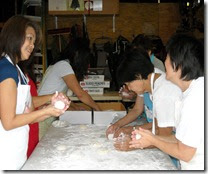 The women worked quickly with skilled hands. Before long there were several boxes filled with perfectly round, plump mochi cakes. This whole process continued all morning.
I got an opportunity to participate in most aspects of the process. I started off mashing. The least skilled part, the grunt work. After mashing several batches, one of the men asked if I wanted a turn pounding. I had entered the holy grail of the process, the only part with spectators. On my second turn at pounding, I thought I was beginning to get the hang of it. One of the older men complimented me on my pounding technique. After working up a considerable sweat with the men, I asked the women if I could join them. They graciously made room for me at the table. Having worked as a baker years ago, it was somewhat familiar territory. I even received a few nods of approval at some of my finished products. I realized however that my mochi cakes weren't as smooth as the others and took me a lot longer to make.
I recently looked up a mochi recipe on the internet. It starts with rice flour and the cooking is done in the microwave. It only takes minutes from start to finish. What a difference from the process I had participated in. There is even a mochi machine, like a bread maker. It's all done automatically; you just add the ingredients. But the process Katie and I participated in wasn't about making the family's mochi. I witnessed this extended Japanese American family contentedly talking and laughing through an extremely labor-intensive, time-consuming process. This is something they do every year and something their mothers and fathers, uncles and aunts who are long gone did as well. Like Tan’s family, this family set aside some of the food for altars on New Year’s Eve. In both cases I had no doubt that the ancestors were right there, celebrating the occasion through the eyes of their children’s, children's, children, just as they'd done for centuries.

 This is the most tedious part and even our 6-year- old grandson, Christopher, was even allowed to do this. This took about 5 to 10 minutes and was the most tiring part of the whole process. One of the older men kept checking to see if the rice granules were broken down enough. When given the OK, the rice mashers stepped aside and another man, wielding a large wooden mallet, began to rhythmically pound the rice. The pounding seemed to be the centerpiece of the mochi making process and the part that transformed the sticky mass into a rubberier substance. Everyone stopped to watch. The mallet was heavy and needed to come down with force and accuracy. Between each pound, another man moistened and turned the ever-thickening batch. When the glutinous product was ready, it was placed on the table where the women are standing. Each time this was done, the women commented on the look and feel of that particular batch. Now the forming of the mochi cakes began.
 The women worked quickly with skilled hands. Before long there were several boxes filled with perfectly round, plump mochi cakes. This whole process continued all morning.
 I got an opportunity to participate in most aspects of the process. I started off mashing. The least skilled part, the grunt work. After mashing several batches, one of the men asked if I wanted a turn pounding. I had entered the holy grail of the process, the only part with spectators. On my second turn at pounding, I thought I was beginning to get the hang of it. One of the older men complimented me on my pounding technique. After working up a considerable sweat with the men, I asked the women if I could join them. They graciously made room for me at the table. Having worked as a baker years ago, it was somewhat familiar territory. I even received a few nods of approval at some of my finished products. I realized however that my mochi cakes weren't as smooth as the others and took me a lot longer to make.
I recently looked up a mochi recipe on the internet. It starts with rice flour and the cooking is done in the microwave. It only takes minutes from start to finish. What a difference from the process I had participated in. There is even a mochi machine, like a bread maker. It's all done automatically; you just add the ingredients. But the process Katie and I participated in wasn't about making the family's mochi. I witnessed this extended Japanese American family contentedly talking and laughing through an extremely labor-intensive, time-consuming process. This is something they do every year and something their mothers and fathers, uncles and aunts who are long gone did as well. Like Tan’s family, this family set aside some of the food for altars on New Year’s Eve. In both cases I had no doubt that the ancestors were right there, celebrating the occasion through the eyes of their children’s, children's, children, just as they'd done for centuries.
Wednesday, December 29, 2010
Learning From the Existentialists
I've been listening to a lecture series on existentialism. The focus is on philosophers Kierkegaard, Heidegger, Nietzsche, Camus and Sartre. These are some heavy dudes. The lecturer points out all the many ways they disagree and also the common philosophical thread that runs through their work: the way to find true freedom in this life is by taking total responsibility for one's choices and one's responses to the events of life. This is called living an authentic life. An authentic life has passion and commitment. Most people live much of their lives in a reactionary mode. Almost everyone has brief moments of clarity, but the life of the ordinary person is generally unreflective in nature. The existentialists encourage us to live our lives in the present and make our decisions through reflective choice.
In conformity, one does the right thing because that is what's expected by others. Non- conformity is the other side of the coin. The rebellion of youth is an example of this. Both are reactionary ways of existing. Following the existential philosophy one may conform or rebel, but the choices are made reflectively and in this way one’s life becomes more “authentic”. Sartre found authenticity in the French underground. Rebelling against the Nazis gave him meaning and purpose that transcended his individual needs and wants. Viktor Frankl found it when he was a prisoner in a concentration camp. Helping the other prisoners gave him the meaning he needed to survive. The existentialists tell us that finding meaning in life leads to true freedom.
When I first attended college at Florissant Valley Community College in North St. Louis County, it was1965 and I guess I wasn't ready. I flunked out. My concerned parents sent me to a counselor, who advised me to go into the military. He told me “Not everyone is cut out for college.” But at some point during my Army experience, I decided I wanted an education. My heroes were writers. Not just writers, but writers and adventurers like Hemingway, Jack London and Jack Kerouac. Both Jacks were in the Merchant Marines for a while. When I was a soldier on my way to Vietnam aboard a Merchant Marine troopship, I enviously watched the sailors as they went about their daily chores. They worked hard and had purpose throughout their day, unlike us soldiers, the cargo, who had absolutely nothing to do. We sat or wandered around the ship with too much time to think about where we were headed. I imagined myself as one of those seaman, after a hard day's work, lying on my bunk in the evening, making entries in my journal for a novel I would someday write.
In Kerouac's novel On The Road, he describes living and working with migrant workers. He describes this as a deeply satisfying time in his life, doing exhausting work in the fields all day and then falling into bed at night tired but happy. The long tedious hours of back breaking work forced him to engage fully in life. For Hemingway it was imminent death that forced his characters into this open, honest and vital way of living.
Some of the existentialists spend too much time raging against normalcy. Reacting in a negative way to the bland, unaware, mundane, un-passionate existence of others is just another reactionary mode. Without compassion for the human condition, we miss the mark. When we truly face our own inevitable death, when we truly face our ultimate aloneness in the world, when we become quiet and genuinely reflective, we discover a deep connection with and compassion for all life. The peace and security people yearn for can only be found by letting go of striving for it. Totally accepting oneself in whatever situation one is in is the way to true freedom. The Buddhists' call it non-attachment or the middle way. Let go of all clinging and be totally present.
In conformity, one does the right thing because that is what's expected by others. Non- conformity is the other side of the coin. The rebellion of youth is an example of this. Both are reactionary ways of existing. Following the existential philosophy one may conform or rebel, but the choices are made reflectively and in this way one’s life becomes more “authentic”. Sartre found authenticity in the French underground. Rebelling against the Nazis gave him meaning and purpose that transcended his individual needs and wants. Viktor Frankl found it when he was a prisoner in a concentration camp. Helping the other prisoners gave him the meaning he needed to survive. The existentialists tell us that finding meaning in life leads to true freedom.
When I first attended college at Florissant Valley Community College in North St. Louis County, it was1965 and I guess I wasn't ready. I flunked out. My concerned parents sent me to a counselor, who advised me to go into the military. He told me “Not everyone is cut out for college.” But at some point during my Army experience, I decided I wanted an education. My heroes were writers. Not just writers, but writers and adventurers like Hemingway, Jack London and Jack Kerouac. Both Jacks were in the Merchant Marines for a while. When I was a soldier on my way to Vietnam aboard a Merchant Marine troopship, I enviously watched the sailors as they went about their daily chores. They worked hard and had purpose throughout their day, unlike us soldiers, the cargo, who had absolutely nothing to do. We sat or wandered around the ship with too much time to think about where we were headed. I imagined myself as one of those seaman, after a hard day's work, lying on my bunk in the evening, making entries in my journal for a novel I would someday write.
In Kerouac's novel On The Road, he describes living and working with migrant workers. He describes this as a deeply satisfying time in his life, doing exhausting work in the fields all day and then falling into bed at night tired but happy. The long tedious hours of back breaking work forced him to engage fully in life. For Hemingway it was imminent death that forced his characters into this open, honest and vital way of living.
Some of the existentialists spend too much time raging against normalcy. Reacting in a negative way to the bland, unaware, mundane, un-passionate existence of others is just another reactionary mode. Without compassion for the human condition, we miss the mark. When we truly face our own inevitable death, when we truly face our ultimate aloneness in the world, when we become quiet and genuinely reflective, we discover a deep connection with and compassion for all life. The peace and security people yearn for can only be found by letting go of striving for it. Totally accepting oneself in whatever situation one is in is the way to true freedom. The Buddhists' call it non-attachment or the middle way. Let go of all clinging and be totally present.
Saturday, December 18, 2010
Pick of the Litter
I got first pick of the litter. Cheska was Suzanne's dog, the mother, and the father was a dog named Red. Both dogs were Springer Spaniels, although Red was so big we suspected he might not be pure-bred. Cheska was medium to small size, had reddish brown(liver) on her back with a white underbelly and white on her legs and muzzle. She could be dependent and whiny, whereas Red was strong, independent and had a regal appearance. Red's body was white with a smattering of reddish spots. Most of the color was on his head. He was owned by Suzanne's former boyfriend.
Suzanne and I lived together for a time in the early '70s, when one could easily drift in and out of relationships. Ours wasn't meant to last, but we shared a deep love of dogs as well as love and respect for each other. She was still living in Eugene in the house we bought together, but I had moved to Seattle and was eking out a living as a fry cook during the day and cab driver at night. I had been dog-less since my beagle, Blossom, was run over by a car driven by a young man going way too fast on a country road. I wasn't sure I wanted another one.
But getting pick of the litter was quite an honor and I was secretly pleased that Red's master was getting second choice. I can't remember how many puppies were in the litter, but a lot, maybe 8 to 10. Suzanne called me when they were old enough to adopt. There is absolutely nothing cuter than a bunch of Springer puppies. I couldn't resist and took my time watching them before making my decision.
Suzanne let me know which puppy the ex-boyfriend wanted. It was the biggest male with the droopiest face. He was lethargic, spending most of his time sitting and watching the other puppies play. There was something appealing about his mellow nature and for a while I thought he was the one I wanted. It may have also had something to do with taking the dog that Suzanne's irresponsible, cavalier yet ruggedly handsome ex wanted. But as I continued watching the puppies, I kept noticing one medium sized male, always on the move. Some of the puppies fought a lot, some slept most of the time and some whined until mom returned to feed them. But this little male went around bumping the other dogs with his nose until he got one of them to play with him. He didn't get angry or give up. He would bump a puppy, back up and then furiously wag his cropped tail. After two or three times of this, without response, he would move on to the next one.
When I touched his back, he looked up at me and for a brief moment I could tell he thought maybe I'd play with him. But when he realized I was just sitting there watching like that fat puppy in the corner, he again turned his attention to the other dogs.
I named him Murray after the Jason Robards character in the movie A Thousand Clowns. Murray was a writer for a children's television show. But he grows to hate the shows host and the conformity of it, so he quits. Murray realized that most people go through their lives reacting and conforming to others and to the “system” and lose the basic childlike joy of living. His nephew Nick lives with him and Murray wants him to live life with gusto and to stand up to the hypocrisy and phoniness of others. Throughout the movie Murray tries to act as an example for his nephew. In one scene he goes out into the street very early in the morning, looks up at the New York apartment buildings and begins yelling at them as if he were a camp counselor. “Campers, volleyball will be held out on the main lawn at 10 am sharp”.
I lived with Murray the Springer for over 15 years. We ran together, hiked together, lived in a variety of houses and towns. He endured my ups and downs with girlfriends and marriages. He loved and played with my son and two stepsons. He tolerated our other pets as they came and went. Throughout it all, I could count on him to bump me on the leg each morning wag his stump of a tail, back off and look at me straight in the eye as if to say, Isn't it great to be alive. What fun activities are we going to do today?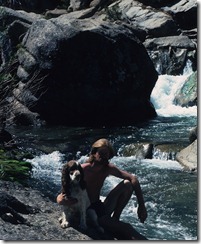
Murray had a stroke in 1990. His left side stopped working. When I took him to the Vet to be put down, we took a few minutes to sit outside the office by the side of a small stream. He knew something was wrong, but when he heard the birds chirping in the trees, his floppy ears perked up and he looked at me. Again I saw that little puppy. What do you say we go chase after those birds? I'm reminded of the Jerry Jeff Walker song Mr. Bogangles. “His dog up and died... after 20 years he still grieves.” It's been over 20 years since Murray died and I haven't gotten another dog and probably won't.
Suzanne and I lived together for a time in the early '70s, when one could easily drift in and out of relationships. Ours wasn't meant to last, but we shared a deep love of dogs as well as love and respect for each other. She was still living in Eugene in the house we bought together, but I had moved to Seattle and was eking out a living as a fry cook during the day and cab driver at night. I had been dog-less since my beagle, Blossom, was run over by a car driven by a young man going way too fast on a country road. I wasn't sure I wanted another one.
But getting pick of the litter was quite an honor and I was secretly pleased that Red's master was getting second choice. I can't remember how many puppies were in the litter, but a lot, maybe 8 to 10. Suzanne called me when they were old enough to adopt. There is absolutely nothing cuter than a bunch of Springer puppies. I couldn't resist and took my time watching them before making my decision.
Suzanne let me know which puppy the ex-boyfriend wanted. It was the biggest male with the droopiest face. He was lethargic, spending most of his time sitting and watching the other puppies play. There was something appealing about his mellow nature and for a while I thought he was the one I wanted. It may have also had something to do with taking the dog that Suzanne's irresponsible, cavalier yet ruggedly handsome ex wanted. But as I continued watching the puppies, I kept noticing one medium sized male, always on the move. Some of the puppies fought a lot, some slept most of the time and some whined until mom returned to feed them. But this little male went around bumping the other dogs with his nose until he got one of them to play with him. He didn't get angry or give up. He would bump a puppy, back up and then furiously wag his cropped tail. After two or three times of this, without response, he would move on to the next one.
When I touched his back, he looked up at me and for a brief moment I could tell he thought maybe I'd play with him. But when he realized I was just sitting there watching like that fat puppy in the corner, he again turned his attention to the other dogs.
I named him Murray after the Jason Robards character in the movie A Thousand Clowns. Murray was a writer for a children's television show. But he grows to hate the shows host and the conformity of it, so he quits. Murray realized that most people go through their lives reacting and conforming to others and to the “system” and lose the basic childlike joy of living. His nephew Nick lives with him and Murray wants him to live life with gusto and to stand up to the hypocrisy and phoniness of others. Throughout the movie Murray tries to act as an example for his nephew. In one scene he goes out into the street very early in the morning, looks up at the New York apartment buildings and begins yelling at them as if he were a camp counselor. “Campers, volleyball will be held out on the main lawn at 10 am sharp”.
I lived with Murray the Springer for over 15 years. We ran together, hiked together, lived in a variety of houses and towns. He endured my ups and downs with girlfriends and marriages. He loved and played with my son and two stepsons. He tolerated our other pets as they came and went. Throughout it all, I could count on him to bump me on the leg each morning wag his stump of a tail, back off and look at me straight in the eye as if to say, Isn't it great to be alive. What fun activities are we going to do today?

Murray had a stroke in 1990. His left side stopped working. When I took him to the Vet to be put down, we took a few minutes to sit outside the office by the side of a small stream. He knew something was wrong, but when he heard the birds chirping in the trees, his floppy ears perked up and he looked at me. Again I saw that little puppy. What do you say we go chase after those birds? I'm reminded of the Jerry Jeff Walker song Mr. Bogangles. “His dog up and died... after 20 years he still grieves.” It's been over 20 years since Murray died and I haven't gotten another dog and probably won't.
Subscribe to:
Posts (Atom)