Wednesday, May 6, 2015

Finding An Old Friend


Last November I wrote a blog summarizing my year in Vietnam. On April 20th there was a comment left from a Vietnamese Interpreter I worked with in Vietnam from 1967-68. He simply identified himself as Nguyen Van Tuat.  I was ecstatic.


Tuat is 3rd from the left
Tuat’s son somehow found the  blog,  where he saw a picture of his dad as a young man.                 


Shortly after my unit, the 635th MI detachment, 198th Brigade, got set up at our basecamp near Chu Lai, two Interpreters were assigned to us, Le Van Chang and Nguyen Van Tuat. Both were about twenty years old like myself. They were the first Vietnamese people I got to know. Both Tuat and Chang were friendly and loved to laugh and joke around.
Chang, Tuat and me at the beach on the South China Sea


We worked together every day, interrogating detainees or going on Intelligence gathering missions. We hung out in each other’s hooch’s  in the evenings, talking and eating snacks or C-rations.
When we had time off, we went to the beach.


Me & Tuat


Chang before he was shot
On New Year’s Eve 1967, Chang was shot by “friendly fire”. Tuat and I went up to the hospital to be with him. He was shot in the shoulder and survived. A month later he was back working in our unit.


When I returned home in October of 1968, I left them there in the war. Over the next 46+ years, I had no way of knowing whether they survived the war and the communist takeover in 1975.  So when I received the message from Tuat, I was relieved to discover that he was still alive.

I’ve Skyped with Tuat twice so far. He told me that Chang also survived and is now living in the US somewhere. We expressed our happiness to have found each other after all these years. We’re now both 67 years old, but talking with him face to face on the computer screen, I could still see that young man I knew from all those years ago.  He told me that after the war he ran away and hid, but the communists found him and put him in a “re-education camp”. He described the experience  with tears in his eyes as “bullshit” and “very bad”.                                                                       

Tuat, Duy Anh, Hue
When we first Skyped, Tuat was working long hours, six days a week on a farm. The second time he told me he got a different job, at a hotel. He said the work would be a lot easier, even though the pay was still very low. Hue also works as a cook and Duy Anh is in his last year of high school. Tuat is determined to send his son to college, so he can have a better life.

Katie and I have plans to travel to the Far East next year and I am looking forward  to visiting my old friend Tuat and his family.


Friday, January 2, 2015

Bob Dylan and Bobby Vee


I often watch youtube music videos of some of my favorite artists. The other day I ran across a clip from a Dylan concert at Midway Stadium in St. Paul, Minnesota from July 10, 2013. When the audience quieted down, Dylan stepped up to the mic and said, “I’ve played all over the world with everybody from Mick Jagger to Madonna and everybody in between… but the most meaningful person  I’ve ever been on stage with, who’s here tonight, used to sing a song called Suzie Baby." Dylan then introduced Bobby Vee to the audience. The band started playing and Dylan sang Suzie Baby, an unremarkable, simple early rock & roll sounding song, which I’d never heard before.

Did I hear him right? I dragged the cursor back and listened again. Sure enough, Bob Dylan just said the most meaningful person he’d ever been on stage with was Bobby Vee. If you were alive in the early 1960s and turned on a radio, you'd have heard Bobby Vee. He had a string of hits: Devil or Angel, Rubber Ball, Take Good Care of my Baby (written by Carole King and Gerry Goffen), Run to Him and The Night has a Thousand Eyes to name a few. Between 1959 and 1970, Bobby Vee had 38 top 100 hits and 7 gold records. He was part of the popular music phenomenon that filled a void shortly after 1959. Around that time Elvis entered the army, Little Richard quit singing to become a preacher, Jerry Lee Lewis went to jail for marrying his 14 year old cousin and Buddy Holly along with the Big Bopper and Richie Valens died in a plane crash. Early rock & roll was all but dead and into the void rushed a bunch of good looking male singers, singing catchy pop tunes. We called it “bubble gum music”. It’s greatest appeal was to young teenage girls, “bubblegummers”.  Bobby Vee was one of the most popular of the bubble gum hit makers.

In 1964 rock & roll was revived by the Beatles and Dylan. Dylan’s influence spawned the birth of the singer/songwriter and blended folk and rock music. Popular music moved away from the catchy pop songs of singers like Bobby Vee and became more relevant and meaningful with more musical complexity.  So why is Dylan so reverential towards a pop star, who sang the kind of music that he broke away from and stood in stark contrast to. To understand this we have to go back to “the day the music died”, as Don McLean put it in his song American Pie.   

 On February 3, 1959, a plane crashed in Minnesota killing Buddy Holly, the Big Bopper and Richie Valens along with the pilot. They were part of a concert tour called Winter Dance Party, which also featured Dion and the Belmonts. The plane was on its way to Moorhead, Minn for their next concert. It was a tragedy, but the concert tickets were sold and the manager wanted the show to go on. He put an add out on the radio for a band who could fill in. A local group made up of the Velline brothers, Sidney and Bill, responded to the add and were asked to fill in for the lost musicians. Sidney and Bill let their 15 year old brother Bobby sit in with the band for the concert. Bobby had been perfecting a singing style that sounded like Buddy Holly, which made him perfect for the gig. Just before the performance, the Velline brothers were asked what their group was called and Bobby spontaneously said "The Shadows".  The Shadows were a hit that night and went on to record four sides for the Soma label, one of the songs being Suzie Baby , featuring Bobby singing in his Buddy Holly style.

In the summer of 1959, The Shadows hired an 18 year old musician from Hibbing, Minnesota who was working in Fargo as a busboy at the Apple CafĂ©, named Bobby Zimmerman. Here is how Dylan puts it in his autobiographical book Chronicles Volume One. Talking about Bobby Vee he writes, “In the summer of ’59, he had a regional hit record out called Suzie Baby on a local label. His band was called The Shadows and I had hitchhiked out there and talked my way into joining his group as a piano player on some of his local gigs, one in a basement of a church. I played a few shows with him, but he really didn’t need a piano player and besides, it was hard finding a piano that was in tune in the halls that he played.”


The young Dylan credits Bobby Vee for inspiring him to go on in his own career.  He admired Bobby,thought he had a great Rock-a-Billy style of performing and was grateful to be given an opportunity to play with his band. They both left the mid-west and had extremely divergent careers. Bobby Zimmerman went to New York, where he changed his name to Bob Dylan and invented his Woody Guthrie, troubadour persona and  Bobby Velline got picked up by Liberty records, changed his name to Bobby Vee and became a pop star and teen heartthrob .

Dylan says in Chronicles: “ Bobby Vee and me had a lot in common, even though our paths would take such different directions. We had the same musical history and came from the same place and the same point of time.” “I’d always thought of him as a brother. Every time I’d see his name somewhere, it was like he was in the room.”

In 2011 Bobby Vee was diagnosed with Alzheimer’s disease. With this knowledge, he traveled to Arizona and with his family recorded a final album called “The Adobe Sessions”.

Saturday, November 8, 2014

My Year in Vietnam


In 1966, like many young men my age, the US government forced me to make a choice. I could either join the military, go to jail or flee the country. I joined the Army.


I turned twenty in October of 1968 on a Merchant Marine troop ship headed for Vietnam. On the month long voyage, somewhere out in the Pacific ocean, one fellow soldier jumped overboard and was never found. The rest of us had a good idea why he jumped.


We stopped in the Philippines and were allowed two days of shore leave. Some of us spent the day at the beach swimming and collecting beautiful brightly colored shells. 

I spent most of my year living and operating out of the 198th Infantry Brigade Headquarters. 


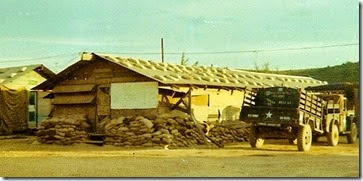
I lived in this hooch with five other guys. We were all part of the 635th Military Intelligence Detachment. Several of the other surrounding hooches held personnel from our detachment as well.

We fixed up the inside by building a bar covered with grass cloth to give it a tropical look and surrounded it with empty bottles of alcohol that we had consumed. We each chose two playboy pinups and I put up a large drawing of Mick Jagger.  Dennis from Tennessee was our mechanic and company scrounger. He could get just about anything we wanted trading with the Air Force personnel up at the Chu Lai Airbase. 

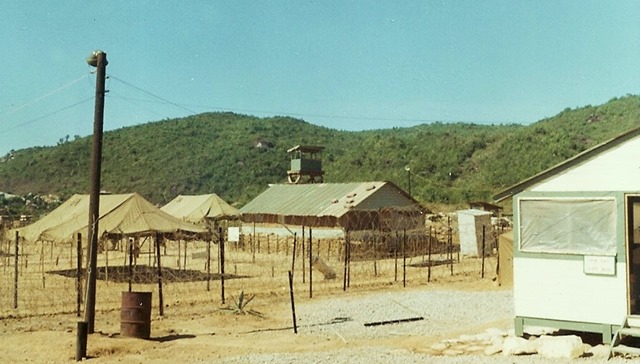
I worked as an Intelligence Analyst and a Prisoner of War Interrogator. This is the POW compound where the detainees were held before and after interrogation.


I flew around in helicopters for both my jobs. Mostly I flew in the Bell UH-1 Iroquois, better known as “Huey”. Hueys had two door gunners, so when the bad guys shot at us, we could shoot back.


Sometimes I flew in a smaller helicopter, the Bell H-13 Sioux. It was a light utility helicopter and had no armaments to protect us. The pilot either flew very high up, out of small arms range or very close to the ground, almost at tree top level. I always sat on my flak jacket and had my rifle ready to fire on these trips. It is an understatement for me to say, I went on some wild rides.
We lived and worked with Vietnamese Interpreters. These young men were drafted into the army for however long the government wanted them. I became very close to these guys. I will never know if they survived after 1975 when the communists took over.


 Anton was a small group of shops that sprung up along highway one. We took our laundry to Helen’s, where you could buy toiletry items, food  and souvenirs. In the back beautiful young girls, who should have been in school or at home with their families, worked as prostitutes.
We named our jeeps. The one to the right  says “dead chicken” in Vietnamese. I named my jeep “Luv”, spelled like the rock group. The Beatles told us that was all we needed and I think I wanted to spread a little more around.  


The two interpreters in the above picture were ethnic Chinese, but born and raised in Vietnam. They were not totally accepted by the Vietnamese, but they were both very good, honorable guys.


Each interrogator chose an interpreter to work with. I mostly worked with Chang  at our interrogation section in the base camp and out in the bush when we went on missions with the infantry. On New Years eve Chang was shot by not so friendly, friendly fire, but he survived and was able to return to our unit.

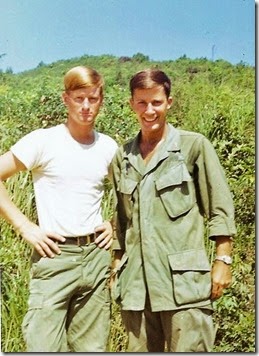
Rob & I
Rob & I

Bao worked with Rob. Bao was college educated and spoke many languages including French. Rob also had a college degree and had lived in France for two years. So he and Bao conducted their interrogation sessions in French and Vietnamese. 
Being in a war with others, you make close friends and have a great deal of respect and trust for one another. Rob was a fellow interrogator and helped me to quit smoking.


The little boy we called Sam
Me, Sam & Owen Davis(OD)
 My friend Owen is barbequing at one of our many detachment cook outs. The little boy, we called Sam was sort of a company mascot. I don’t know if he had a family or was an orphan. One night when both Owen and I were on perimeter guard duty, we were attacked. OD grabbed a radio and ran between bunkers and tanks and coordinated our defensive fire. He really acted heroically that night and saved our bacon. We  laughed about it later over a couple of beers. 

Lt. Mitchell was part of the Imagery Interpretation section of our unit. I took this picture early one morning when he was waiting to go out on a flight mission to take surveillance pictures which would later be analyzed in the Imagery Interpretation van at headquarters. He was an avid reader like myself and we loved to discuss books.  L.T. was shot down on one of these flights, but luckily survived to tell the tale.

Vietnam is a beautiful country. I loved the culture, the country-side and the people. While I was there I tried to imagine the country without a war.  
This is the bus from Tam Ky to Quang Ngai. As you can see no space was wasted.


I bought a Fujica camera at the Division PX. and decided I would not take pictures of injured or dead Vietnamese or Americans. There were too many to count, but out of       respect, I put my camera away.

 This is the amphitheater at Chu Lai, where in December we  saw the Bob Hope Christmas show. We all loved it and felt so much appreciation for Bob and his entourage.
In the background is the hospital where I interrogated many wounded Vietnamese and where the American dead and wounded soldiers were brought in from the field.

                                         
Rick Wright & John Mitchell

 Rick and I went through Intelligence training together at Fort Holibird Maryland. Shortly after settling into the 198th base camp, he was transferred to a small Intel post in Quang Ngai City. Mitch called me "Lil Bro" and introduced me to south east Asian cannabis. We shared a love for Motown music especially the Temptations and Marvin Gaye.


The  largest city I went to was Quang Ngai. Visiting my friend Rick there was a treat. We sat in restaurants and ate meat wrapped in leaves and dipped in nuoc mam(fish sauce) and drank warm Ba Moui Ba(33) beer.
 

I am standing with a married Viet Cong (VC), couple who defected. They were part of the Chieu Hoi program,  a  propaganda campaign by the South Vietnamese government. Leaflets were put in artillery shells or dropped from helicopters over enemy territory. They promised defectors no retribution and a bunch of other positive benefits. I have no idea if the government kept their promise. I enjoyed talking with this couple and they gave us a lot of valuable information.


These little three wheeled vehicles transported civilians up and down Highway 1. One day I witnessed the aftermath of an accident. A tank had run over one of these vehicles, killing all the civilians. Women and children’s bodies were strewn all over the road. Later that day in the Tactical Operations Center (TOC), I overheard a Colonel arguing with someone over the field telephone about which unit should get credit for the enemy body count from this accident. 
                                                               

In January of 1968 the enemy launched the TET offensive. Rockets and mortars rained down on our base camp in the middle of the night. We ran forcover across the road, dodging tracer bullets and held up in a bunker thinking that we  would soon be over run. Several hooches were totally destroyed and our motor pool took several direct hits. Many vehicles were destroyed. Our first Sergeant’s hooch took a direct hit also and he received shrapnel in his ass. We didn’t like our first Sergeant and thought that was hilarious. He survived and filled out the paperwork for a purple heart that he’d been hoping to get. Some American soldiers were killed that night in our base camp. I didn’t know any of them personally. A few enemy soldiers were found dead within our compound, but we were not over run. The next morning we knocked  a hole in the side of our hooch and began building a humongous bunker so that if and when it happened again, we could quickly dive to safety.


Here I am back “in the world” with a brand new MGB-GT which I bought for $3200 cash from my over-seas combat pay. Except for PTSD issues, I survived that year pretty well.

Monday, August 18, 2014

Ferguson Continues to Shape Lives

The following blog was written by my friend Paul Brehm. We met in cub scouts when we were both nine years old and have remained friends since then. We grew up in Ferguson, Missouri in the '50s and '60s, a more segregated time in history. In 2002 we drove from New York to Ferguson together. If you would like to read about that trip, go to http://aretiredboomer.blogspot.com/2010/04/few-years-ago-i-had-opportunity-to.html. Also I have a category of posts at this blog site  called "Ferguson Stories" with more about Ferguson in the past.


Florissant Street, downtown Ferguson, 1978

I grew up in Ferguson during the 1950s and ‘60s. It was a magical time for this sprawling St. Louis suburb. Nothing to worry about except maybe building a bomb shelter for protection from the looming Communist threat. In the early 1950s, Ferguson was a distant suburb of St. Louis. It required a lot of time to get to the downtown area. There were no highways to speak of and rapid transit did not reach out into the suburbs. So downtown Ferguson was pretty much the center of our universe and was teaming with life, Barbays Market, Quillman's Drugstore, Ben Franklin Five & Dime, Velvet Freeze, Martins Restaurant, Savoy theatre, Sonderagers Bakery, Ferguson Bowling Lanes and of course Ferguson Department Store.


Ferguson Department Store 1978
In hindsight we were blind to the fact that steps away from Ferguson, people experienced a different life, one that probably does not conjure up fond memories. Kinloch, the largest black community west of the Mississippi at that time, bordered Ferguson. Ferguson was not wealthy by any means, but Kinloch spelled abject poverty. Many Ferguson families employed a cleaning lady from Kinloch. We never inquired about where they lived or about their family. It embarrasses me to think that my parents were more concerned about these kind women stealing things from our house. Other than that, we never gave Kinloch a second thought. Adults told us to stay far away from it, so we did. When the roads turned from concrete to dirt, we turned around.


Lake at January-Wabash park where we ice skated every winter.

The Clubhouse at January -Wabash Park
McCluer High School back then
McCluer was our high school. It may still hold the record for the largest graduating  classes in Missouri. Not all white, but nearly so in the ‘60s. The half dozen or so blacks in the school were quiet, respectful, and kept a low profile. It never occurred to me at the time what those students went home to or even where they lived. I wonder what happened to Albert Holmes, one of the few blacks at school. He was a great athlete and a gentle, kind person. I can only wonder where he is today and what he is doing. Didn’t Kinloch have its own schools and if so, why didn’t we play them in sports? 
Ferguson Junior High(Used to be the High School)


In the ‘70s things began to change. When my parents retired to Arizona in 1976, they sold their house in Ferguson Hills. A prominent realtor refused to show it to a black family, so my father confronted him and demanded that he show the house to all interested parties, regardless of race. It was my first realization that Ferguson was all white for a reason. My father invited a black family with young kids to view the house and when he found out they could not afford to pay $25,000, he dropped it to a price they could afford. He told me how pleased it made him that they fell in love with the house, just like he did in 1953.

The Fire Station and Bakery
I no longer live in Missouri, but have, on several occasions, driven down my old street, Ford Drive and watched kids playing just like the old days. It does look different. The trees are bigger, the homes look smaller, and most of the kids are black. I’ve thought of Ferguson often over the years and just assumed that integration was working. But I guess Ferguson wasn’t ready for the change.

I used to tell people I was from a small place near St. Louis that they’ve never heard of. That has changed forever. Even Wikipedia now features these recent troubles. Maybe I’ll tell people I grew up in Florissant from now on. 

Friday, August 15, 2014

Brief Encounter With a Beautician


Sometimes it’s the small moments that open our hearts and connect us as humans. Yesterday I went to Lynnwood to get a haircut. I walked into a hair salon for the first time. I don’t have a lot of hair anymore, so cutting it is not that difficult. The shop had four chairs, all empty and no one seemed to be in the place. She must have heard the door open and close, for out of the back walked a tall Asian woman who asked if she could help me. I told her I needed a haircut and she directed me to one of the chairs. She was all business, efficiently putting the tissue around my neck and covering me with the cloth before proceeding to cut my hair.

               She had a light, gentle touch. After shaving the back of my neck, she brushed her hand across it several times, like a cabinet maker brushing the sawdust off recently sanded wood. I stole glances at her in the mirror as she worked. Probably in her fifties, I could tell she once had been beautiful, but her dress and makeup revealed a desperate battle with age.  Around her neck was a silver necklace with large green stones and on her wrist a matching bracelet. Her hair was jet black and long, pulled up on top of her head with a bit trailing down her back.  Her dress was cinched at the midriff accentuating her still slim body, and her breasts jutted out, riding a little too high for her age. We didn’t talk as she cut my hair.

At the cash register I asked her if she was Vietnamese even though she was too tall and something was strange about her face. Her nose reminded me of Michael Jackson’s, too thin for an Asian. I assume she had work done. But her accent gave her away. She answered, “Yes, I am Vietnamese.” I told her I had been in her country once a long time ago. Her eyes lit up and she asked, “When?” I said it was in the sixties during the war. Her face softened and sadness entered her eyes. I could tell she had been there too at that time.

In that moment, I remembered the beautiful young Vietnamese girls on their way to school dressed in immaculate silk Ao Dais, black pajama pants and stark white tops with slits up the sides. They passed right in front of me in single file, walking softly in sandals across the dirt road. Their clean straight black hair bounced lightly on their backs.  I was a twenty year old soldier, in Quang Ngai city for the day. They looked so young and innocent in the midst of the brutal, dirty war. I said a prayer for them to a God I wasn’t sure I believed in, asking that he protect them from the cruelty and destruction all around.

  I said to the woman who had just cut my hair, “You come from a beautiful country.” She said, “Thank you” and our eyes briefly met sharing an understanding that could not be put into words.  Two survivors from a terrible time long ago. I'm thankful she survived,  and she gave me a really good haircut.


Wednesday, April 2, 2014

A Trip To Florida

Paul with his big catch

When I was fourteen I got the opportunity to fly to Florida with my friend Paul and his dad. We visited Paul’s Aunt Elsie and Uncle Walter in Pompano Beach.
I emailed Paul that I was writing a blog about our 1962 Florida trip and he sent me some pictures.

 
His Aunt and Uncle's house looked like a normal suburban house from the front, but around back it was an entirely different world. A large screened porch looked out onto a perfectly green lawn and a few tropical fruit trees. At the lawn’s edge was a dock with steps going down to a canal where Uncle Walter’s private boat waited. These canals went everywhere. Paul's Aunt Elsie told us that she and Uncle Walt could hop in the boat and go shopping or out to dinner on these waterways. How cool is that?
As soon as we arrived, Aunt Elsie cautioned us about being out in the sun too long.  "The sun is a lot more intense here. You need to take it in small doses at first and build up your tolerance." So Paul and I rubbed sun tan lotion on ourselves and sat out in the sun in short intervals. Paul accurately timed each interval on his watch. We commented to each other how we could feel the superior intensity of the Florida sun on our skin.
Aunt Elsie out back by the canal

At night we slept on two army cots that Uncle Walt set up on the back screened porch. After Paul went to sleep, I lay still on my cot trying to remain awake for as long as possible. I wanted to savor the feeling of the cool breeze that rustled the palm leaves and blew across my face carrying the dizzying mixture of salt air and exotic flowers that smelled like the fruits we'd eaten the day before. But within a few minutes I fell under the spell of the rhythmical lapping of canal water against the sides of the boats and was lulled into a deep sleep.
Uncle Walter on the couch

During the day Paul’s aunt and uncle usually had something planned for us. One day we went to the Everglades and rode in an airboat, a light, flat boat with two huge airplane propellers on the back. When we were out on the open water, the driver gave it full throttle and the boat took off like a rocket. We skimmed over the surface of the water and through tall grass, making large circles and figure eights. It was exhilarating. The driver then slowed the craft down and we crept along the Bayou looking for alligators. We spotted a full grown alligator just as it was sliding off the bank and into the water.
When we returned to the tourist center, we watched Bayou Bob wrestle what looked like a half-dead alligator in a small fenced area. Bayou Bob had a big beer gut and quickly got out of breath as he moved the lifeless alligator around. Bob acted as if he were being viciously attacked, while the gator limply flopped from side to side. Paul and I thought the show was hysterical, but held back our laughter until we got out into the parking lot.
On another day, Paul's dad took us deep-sea fishing. The boat was small and rose and fell with the waves. The Captain showed us how to bait our hooks and cast our lines. My pole was the first to get a strike. It was a big fish and I needed help reeling it in. I had been fighting nausea from the time we’d set sail and when the crewman finally wrestled the twenty pound Kingfish up to the boat and gaffed it in the side, causing some of its guts to spill out, I had to abandon the task at hand and flee to the opposite side of the boat to throw up my breakfast. This however did not relieve the sick feeling. For the rest of the trip, I remained huddled in the corner moaning and praying for the fishing excursion to end. Amazingly when we reached shore, I stepped onto dry land and the sick feeling immediately went away. The captain informed me that I had caught the biggest fish of the day and my picture was taken as I struggled to hold up the big fish. Paul and his dad caught several Yellow tail of average size and we all were happy with the day’s take.
When we got back to Paul's aunt and uncle's house, we looked at the Polaroid pictures from the day. In the picture of me holding the fish, my legs appeared to be about half their normal size. I looked like I had two sticks for legs. “Something is obviously wrong with this photo.” I said to no one in particular. Paul's dad held out his hand, “Let me see.” He looked the picture over, then looked at my legs, and then back at the picture, "I don't see anything wrong with this picture, do you Walt?" He passed it over to Paul's

Me with my abnormally skinny legs and fish 
Uncle Walter who went through the same slow deliberate process of looking at the picture and then at my legs. “Nope, it looks fine to me.” Paul laughed so hard I thought he was going to wet his pants. Of course the more I protested, the more Paul's dad and uncle, denied that there was anything wrong with it. I didn’t really mind being the butt of the joke. I was in Florida with my best friend and we were having a great time. 
Paul's Aunt cleaned and cooked our fish and served them for dinner that evening. I never realized how much I enjoyed fish until then. For dessert she peeled and cut up fresh mangoes from the tree in the backyard. It was a heavenly meal.
The best part of that Florida trip was when no activities were planned by the adults and Paul and I went off on our own to explore and wander up and down the beach, along the canals, and in and out of the local stores. At fourteen, life ahead looked exciting and promising. We talked about comic book characters and TV shows and about girls. We were both extremely nervous about whether we would know what to do if the opportunity to kiss a girl presented itself. We swore an allegiance to each other that whoever entered this intimate realm first, would share all the details with the other.
I've been to Florida many times over the years, but none of them compare to that first trip with my best friend and his dad.

Friday, March 21, 2014

Hawaiian Vacation


Katie and I recently spent thirteen days in Hawaii. The trip was a
combination vacation/child care, which meant a chance to spend time with our grandson Christopher. We've been vacationing in Hawaii together since the 1980s. On this trip, Chris's dad was in Germany on business most of the time, so we were able to stay in his condo in Honolulu.
Katie was born and grew up in Honolulu, so when we go, we spend a lot of time visiting various family members. As we've gotten older the family has dwindled down to a precious few.
View from condo patio looking downtown.


View from patio looking toward Pearl Harbor
Honolulu is a big crowded city, but the people still have the aloha spirit. We drove our grandson back and forth to school, his choir practice and Aikido and all these activities happened during rush hour. When driving in the horrendous traffic though, there was no road rage, horn honking or problems merging lanes.
There were plenty of activities we liked doing right in the city, like walking over to Chinatown in the morning for breakfast noodle soup .


Or visiting the Honolulu Museum of Art.


Having a Latte at a coffee shop at Hawaii Kai Marina
We had plenty of opportunities to get out of the city and enjoy the island of Oahu.

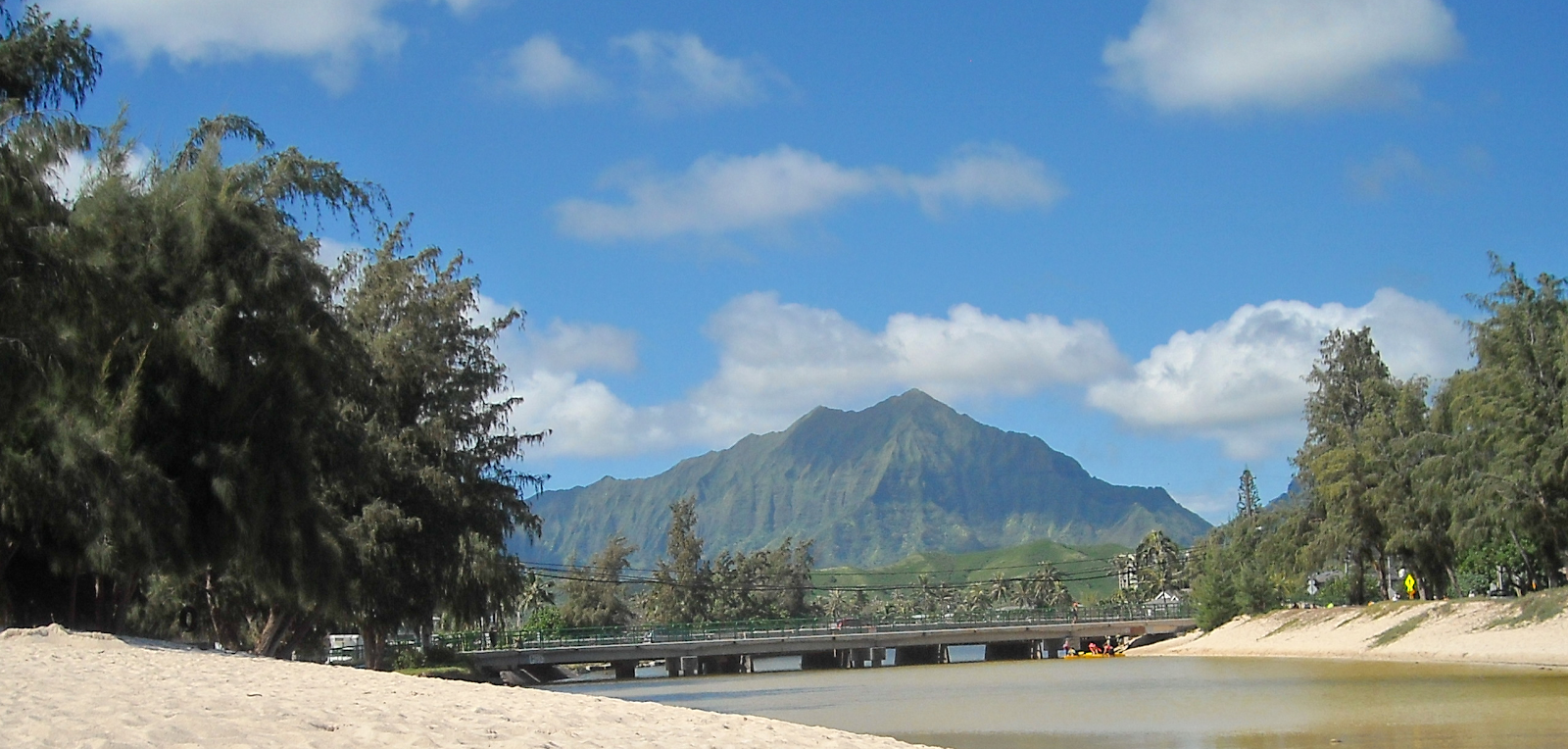
One day we crossed to the other side of the Island on the Pali and visited Kailua.


We swam at one of the many beautiful beaches.


 Just outside of the north shore town of Haleiwa we ate garlic shrimp from a local funky graffitied food trunk. It was delicious.

Walking back to town from the garlic shrimp feast.


Katie had a chance to get together with old friends from junior high and high school. They met at a Chinese restaurant with spouses and we had a many course meal while the five friends reminisced.  Since we were the only couple from the mainland, we were the guests of honor and donned with leis.


On the second to the last day we hiked up the old tram tracks on Koko Head.


It was a grueling hike, but the view from the top was worth it.

I'm always in awe of the plants in Hawaii. Little spindly plants that we nurture in our homes on the mainland are growing wild in Hawaii and are the size of houses. Katie and I toured Foster Gardens near the the condo, where we saw numerous specimens from all over the world.  

Christopher's dad, Peter, finally returned from Germany and we had a great meal at his favorite Vietnamese restaurant.

Our time in Hawaii was wonderful, but the trip home was on a par with one of Dante's levels of hell. We took the red-eye flight home from Honolulu to Phoenix and  then drove two more hours to Green Valley.